See also: Quotes about Bagels
BAGEL FACTS and TRIVIA
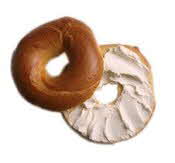
Bagels are the only bread product that is boiled before it is baked.
Bagels are formed from an eggless dough (flour, yeast, water and oil) into a donut shape, then droped in rapidly boiling water, cooked 3 - 5 minutes on one side then flipped and cooked 3 -5 minutes more on the other side. Drained, sometimes brushed with egg and then baked for 10 minutes or so.
According to some, the first bagel rolled into the world in 1683 when a baker from Vienna Austria was thankful to the King of Poland for saving Austria from Turkish invaders. The baker reshaped the local bread so that it resembled the King’s stirrup. The new bread was called “beugel,” derived from the German word stirrup, “bugel.”
“One bit of bagel lore has it that the bagel was invented in 1683, when a Jewish baker in Vienna baked a hard roll in the shape of a stirrup — "bügel" in German — as a thank-you gesture to the cavalry-leading King John III Sobieski of Poland, who had saved the city from Turkish invaders.” Excerpt from Was Life Better When Bagels Were Smaller? in the on line edition of the New York Times, 1/2/04
But then, consider this:
"the first printed mention of bagels...is to be found in the Community Regulations of Kracow, Poland, for the year 1610 – which stated that bagels would be given as a gift to any woman in childbirth."
'The Joys of Yiddish' by Leo Rosten
The derivation of the word bagel is also unclear. Joan Nathan, the author of "Jewish Cooking in America" (Knopf, 1998), says it comes from the German verb "biegen," "to bend."
The late Alan Davidson wrote in his ‘Oxford Companion to Food’ that the word arose from the Yiddish "beygel," itself taken from the German "beugel," meaning ring or bracelet.
When Austria Jews emigrated to America, they brought the beugel with them. The first beugel bakeries were founded in New York City in the 1920s. Later the name was Americanized and called a bagel. Bagels have been used to symbolize the continuous cycle of life—without beginning and without end.
Prepackaged bagels first became available in grocery stores in the 1950’s. Frozen bagels were introduced in 1960.
North Carolina molecular scientist Robert Bohannon has developed 'Buzz Donuts' and 'Buzzed Bagels'- caffeinated donuts and bagels. They contain the caffeine equivalent of 2 cups of coffee. (Jan, 2007)
Also see: Food Articles and Cooking Tips
You are here > Home >
Please feel free to link to any pages of FoodReference.com from your website.
For permission to use any of this content please E-mail: james@foodreference.com
All contents are copyright © 1990 - 2025 James T. Ehler and www.FoodReference.com unless otherwise noted.
All rights reserved. You may copy and use portions of this website for non-commercial, personal use only.
Any other use of these materials without prior written authorization is not very nice and violates the copyright.
Please take the time to request permission.
FOOD TRIVIA and FOOD FACTS

Popular Pages
CULINARY SCHOOLS
& COOKING CLASSES
From Amateur & Basic Cooking Classes to Professional Chef Training & Degrees
Home | Articles | FOOD TRIVIA | Today in Food History | Food_Timeline | Recipes | Cooking_Tips | Food Quotes | Who’s Who | Culinary Schools and Tours | Food_Trivia_Quizzes | Food Poems | Free Magazines | Food Festivals & Events
FoodReference.com (since 1999)
FOOD TRIVIA and FOOD FACTS SECTION