See also: Article about Crabs
BLUE CRABS (Soft Shell Crabs)
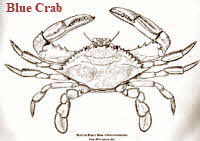
The oldest crab industry in the United States is the blue crab industry of the Chesapeake Bay area, dating back almost to the early 1600s.
Maryland designated the Blue Crab (Callinectes sapidus Rathbun) as Maryland's Official State Crustacean in 1989.
A major American seafood resource, blue crabs are most notably associated with the Chesapeake Bay. The scientific name of this crustacean is Callinectes sapidus, which translates from Latin and Greek to mean beautiful, savory swimmer. Recreational and commercial fishing for blue crab occurs not just in the Chesapeake Bay but also along the Atlantic and Gulf coasts.
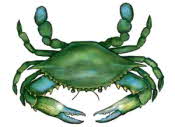
Up to 90% of the Maryland blue crab catch are sold live to restaurants in the Chesapeake Bay area.
Blue crabs play a critical ecological role in estuaries. They feed on small fish, bivalves, other crustaceans, worms, and organic debris and are preyed upon by fresh and saltwater fish, herons, diving ducks and raccoons. Blue crabs are even a favorite food of the endangered Kemp’s Ridley sea turtle that migrate to the Chesapeake Bay every summer.
The total amount of blue crab landed in 2000 was approximately 184 million pounds, approximately 78% coming from just four states, Louisiana, Maryland, North Carolina and Virginia.
Blue crab populations from areas outside the Chesapeake Bay are considered to be stable while those within the Bay are showing significant decline. In 2000, 47 million pounds were landed from the Bay, which is well below the 75 million pounds taken on average over the past 30 years.
To meet blue crab demand, a related species named blue swimming crab is being imported from Asia. More than 70% of the crabmeat products sold in the U.S. contain imported crabmeat.
(Seafood Choices Alliance - www.seafoodchoices.com)
Also see: Food Articles and Cooking Tips
You are here > Home >
Please feel free to link to any pages of FoodReference.com from your website.
For permission to use any of this content please E-mail: james@foodreference.com
All contents are copyright © 1990 - 2025 James T. Ehler and www.FoodReference.com unless otherwise noted.
All rights reserved. You may copy and use portions of this website for non-commercial, personal use only.
Any other use of these materials without prior written authorization is not very nice and violates the copyright.
Please take the time to request permission.
FOOD TRIVIA and FOOD FACTS

Popular Pages
CULINARY SCHOOLS
& COOKING CLASSES
From Amateur & Basic Cooking Classes to Professional Chef Training & Degrees
Home | Articles | FOOD TRIVIA | Today in Food History | Food_Timeline | Recipes | Cooking_Tips | Food Quotes | Who’s Who | Culinary Schools and Tours | Food_Trivia_Quizzes | Food Poems | Free Magazines | Food Festivals & Events
FoodReference.com (since 1999)
FOOD TRIVIA and FOOD FACTS SECTION