See also: Cranberry Juice; Cranberry Bean
CRANBERRIES: CRANBERRY TRIVIA
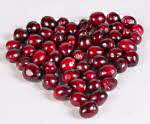
The USDA forecast for U.S. cranberry production in 2014 is 856 million pounds. Wisconsin 538 million pounds, Massachusetts 210 million pounds. New Jersey, Oregon and Washington were also estimated to have substantial production.
Cranberries are ingredients in more than 1,000 food and beverage products.
CRANBERRY PLACES: Cranberry township in Butler County, Pennsylvania (2012 population 28, 832); Cranberry township in Venago County, Pennsylvania (2012 population 6,608); Cranberry, New Jersey (2012 population 2,181); Cranberry Lake, New York (2010 population 200).
There are 14 people in the U.S. listed on whitepages.com with the last name 'Cranberry'
(Mark Morton, 'Gastronomica', Fall 2010)
There are several theories as to the origin of the name 'cranberry.' One is that the open flowers look like the head of a crane; another is that cranes like to these sour berries.
Good, ripe cranberries will bounce. Bounceberry is another name for them
Small pockets of air inside the berry cause the cranberry to bounce. Air also causes berries to float in water.
The Cranberry (Vaccinium macrocarpon) was designated as the Official Fruit of Wisconsin in 2004.
Contrary to popular belief, cranberries do not grow in water. A perennial plant, cranberries grow on low-running vines in sandy bogs and marshes. Because cranberries float, some bogs are flooded when the fruit is ready for harvesting. Others are harvested using machines that resemble lawnmowers that "comb" fresh cranberries off the vines.
If you strung all the cranberries produced in North America in 2007, they would stretch from Boston to Los Angeles more than 565 times.
Native Americans pounded cranberries into a paste and mixed with dried meat, and called this mixture 'pemmican.'
One of the first references to cranberries was made in a letter written by Mahon Stacy to his brother in England dated April 26, 1680.
Cranberry juice was first made by American settlers in 1683.
American and Canadian sailors on long voyages knew they could eat cranberries to protect themselves from scurvy -- making them a cranberry counterpart to British 'limeys.'
The first cranberry sauce was marketed in 1912.
Americans consume some 400 million pounds of cranberries a year, 20 percent during Thanksgiving week.
Americans consume 5,062,500 gallons of jellied cranberry sauce every holiday season.
Jellied cranberry sauce (the log) is most preferred by consumers totaling 75% of overall cranberry sauce sales.
More than 94% of Thanksgiving dinners include cranberry sauce.
Cranberries are almost 90% water.
There are approximately 450 cranberries in a pound, 4,400 cranberries in one gallon of juice, 45,000 cranberries in a 100-pound barrel.
It takes about 200 cranberries to make one can of cranberry sauce.
The Cranberry was made the official state berry of Massachusetts in 1994.
Some cranberry beds are over 100 years old and still producing.
About 95% of cranberries are processed into juice, sauce, dried, etc. Only about 5% are sold fresh.
U.S. Cranberry production for 2012 was estimated at 768 million pounds. Wisconsin was number one with 450 million pounds, followed by Massachusetts with 210 million pounds.
Wisconsin has been the #1 cranberry producer in the U.S. for 19 consecutive years (2013), producing more tha 60% of the nations crop.
The oldest cranberry bed in Wisconsin is 139 years old (2013).
The forecast for U.S. cranberry production in 2008 is 689 million pounds, up 5 percent from 2007 and slightly below 2006. Wisconsin is expected to lead all states in the production of cranberries, with 385 million pounds, followed by Massachusetts (190 million). New Jersey, Oregon and Washington are also expected to have substantial production, ranging from 15 million to 50 million pounds.
In 1996, the worldwide cranberry harvest produced 40 cranberries for every person on the planet.
Honeybees are often used to pollinate cranberry crops, and are in fact more valuable in the performance of this task than they are in the production of honey.
John Lennon confirmed in a 1980 interview that he repeated the words Cranberry sauce at the end of the song Strawberry Fields Forever.
Cowberry, lingonberry, foxberry, mountain cranberry (Vaccinium vitis-idaea). This is an uncultivated member of the cranberry family and is primarily used in northern Europe to make jams & preserves.
About 38,000 acres in Wisconsin, Massachusetts, New Jersey, Oregon and Washington State account for most of the world’s production of cranberries.
Most of the world’s cranberries are cultivated on 37,000 acres in just five states: Massachusetts, Wisconsin, New Jersey, Oregon and Washington. Another 5,000 acres are cultivated in Provinces of British Columbia and Quebec Canada. Maine, Michigan and Minnesota also are experimenting with cranberry production.
Massachusetts is a leading producer of cranberries, with a crop of approximately 1.547 million barrels in 2001.
Of the approximately 1,000 cranberry growers in North America in 2001, 500 were in Massachusetts. Approximately 70 percent of these growers are small family farms with less than 20 acres of bog.
Cape Cod Cranberry Growers' Association
Over 110,000 metric tons of cranberries are produced in the U.S. each year. More than 1/3 of these are made into juice. Cranberries were first cultivated in Massachusetts around 1815. As of 2001, Wisconsin was the leading producer, followed by Massachusetts.
FREE Magazines
and other Publications
An extensive selection of free magazines and other publications
Also see: Food Articles and Cooking Tips

FOOD TRIVIA and FOOD FACTS
Please feel free to link to any pages of FoodReference.com from your website.
For permission to use any of this content please E-mail: james@foodreference.com
All contents are copyright © 1990 - 2025 James T. Ehler and www.FoodReference.com unless otherwise noted.
All rights reserved. You may copy and use portions of this website for non-commercial, personal use only.
Any other use of these materials without prior written authorization is not very nice and violates the copyright.
Please take the time to request permission.
Popular Pages
CULINARY SCHOOLS
& COOKING CLASSES
From Amateur & Basic Cooking Classes to Professional Chef Training & Degrees
FoodReference.com (since 1999)
Home | Articles | FOOD TRIVIA | Today in Food History | Food_Timeline | Recipes | Cooking_Tips | Food Quotes | Who’s Who | Culinary Schools and Tours | Food_Trivia_Quizzes | Food Poems | Free Magazines | Food Festivals & Events
You are here > Home >
FOOD TRIVIA and FOOD FACTS SECTION