
Home | FOOD ARTICLES | Food Trivia | Today_in_Food_History | Food_History_Timeline | Recipes | Cooking_Tips | Food_Videos | Food_Quotes | Who’s_Who | Culinary_Schools_&_Tours | Food_Trivia_Quizzes | Food_Poems | Free_Magazines | Food_Festivals_and_Events
Food Articles, News & Features Section
FREE Magazines
and other Publications
Free Professional and Technical Research, White Papers, Case Studies, Magazines, and eBooks

EGGPLANT
See Also: Eggplant Identity Crisis; Trivia; Cooking Tips; Quotes
Eggplant is a member of the nightshade family and is native to India. The early varieties were bitter, but cultivation and crossbreeding have greatly improved the flavor. Eggplant is related to potatoes, tomatoes, and peppers.
Eggplant isn't a particularly popular vegetable in the United States, but it's a favorite in many areas of the South. Thomas Jefferson, who experimented with many varieties of plants in his Virginia garden, is credited with introducing eggplant to North America.
In various parts of Europe, people suspected that eating eggplant caused madness, not to mention leprosy, cancer, and bad breath, which is why eggplant was used mostly for decoration in England and the United States nearly up to the 20th century
Florida produces the bulk of the domestic harvest, and New Jersey is a major supplier during the summer months.
 Varieties:
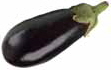
The dark purple eggplants are the most common type sold commercially in the United States. They weigh about 1 to 5 pounds each and come in two shapes: oval and elongated. The elongated variety is often referred to as the Japanese or oriental eggplant.
Specialty varieties include miniature eggplants that come in a variety of colors and shapes.
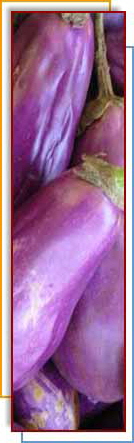
- Deep purple, round or oval eggplants are often nicknamed Italian or baby eggplants.
- Pale violet eggplant, usually slim and light, is nicknamed Chinese eggplant.
- Violet-white are Italian rosa biancos
- Japanese eggplants are younger versions of the large commercial purple type.
 Availability
Eggplants are available all year. Their peak growing season in the United States is from July to October.
Selection:
Look for a symmetrical eggplant with smooth, uniformly colored skin. Tan patches, scars, or bruises indicate decay. Also avoid eggplants with wrinkled or flabby-looking skin. Oversized purple eggplants, usually over 6 inches in diameter, may be tough and bitter.
When you press gently on an eggplant, the finger mark will disappear quickly if the eggplant is fresh. Eggplant should feel heavy; one that feels light for its size may not have a good flavor. The stem and cap should be bright green.
Storage:
Both cold and warm temperatures can damage eggplant. It is best to store eggplant uncut and unwashed in a plastic bag in the cooler section of the refrigerator. Do not force the eggplant into the crisper if it is too big, as this will bruise the vegetable. Eggplant may be blanched or steamed then frozen for up to 6 months.
Preparation:
Wash the eggplant just before using it, and cut off the cap and stem. Use a stainless steel knife because carbon blades will discolor the eggplant. Eggplant should not be eaten raw. Eggplant may be cooked with or without its skin. However, large eggplant and most white varieties have thick, tough skin and should be peeled prior to cooking with a vegetable peeler.
Unlike many vegetables, eggplant is not harmed by long cooking. An undercooked eggplant can have a chewy texture; but overcooked eggplant is just very soft. Do not cook in an aluminum pot because the eggplant will become discolored.
Spices that enhance its flavor include allspice, basil, bay leaves, garlic, chili powder, oregano, sage, thyme, marjoram, and parsley. Eggplant is most often paired with tomatoes or onions.
 Word to the Wise:
According to an Australian study, eggplant absorbs more fat in cooking than any other vegetable. When researchers deep-fried a serving of eggplant, they found that it absorbed 83 grams of fat in just 70 seconds—four times as much as an equal portion of potatoes—adding more than 700 calories. Try one of the many other cooking options instead of frying or sautéing. (Wellness Encyclopedia of Food and Nutrition).
Baking:
To bake a whole eggplant, pierce the skin with a fork several times, and cook it at 400 degrees for 30 to 40 minutes. Baking whole eggplants produces a soft flesh that is easy to mash or puree.
Broiling:
Cut the eggplant into thick lengthwise slices, and score them lightly with a sharp knife. Place the slices on a broiler pan or grill; brush them lightly with oil. Broil about 5 inches from the heat, and turn slices when they begin to brown. Eggplant should be cooked for approximately 5 minutes per side.
Eggplant may also be microwaved whole, cubed, or sliced. Cooking times vary from 6 to 8 minutes for a whole eggplant to 3 or 4 minutes for a pound of cubed eggplant.
Stewed eggplant is called ratatouille. For this dish, eggplant may be stewed alone, or with other vegetables. Simmer, covered with a liquid such as tomato juice, until the eggplant is tender. The cooking time is usually 20 to 25 minutes.

Make Eggplant Part of Your 5 A Day Plan
- Sprinkle minced garlic and herbs over eggplant slices before grilling for extra taste.
- Add eggplant to lasagna to add color, taste, and texture.
- Blend eggplant to spinach dips or other vegetable dips.
- Add eggplant to vegetable soups to for a heartier texture.
- Grill eggplant, and add it to your favorite sandwich.
- Try eggplant seasoned and mashed or pureed as a dip with pita bread.
RELATED ARTICLES
Please feel free to link to any pages of FoodReference.com from your website.
For permission to use any of this content please E-mail: james@foodreference.com
All contents are copyright © 1990 - 2025 James T. Ehler and www.FoodReference.com unless otherwise noted. All rights reserved.
You may copy and use portions of this website for non-commercial, personal use only.
Any other use of these materials without prior written authorization is not very nice and violates the copyright.
Please take the time to request permission.