
Home | FOOD ARTICLES | Food Trivia | Today_in_Food_History | Food_History_Timeline | Recipes | Cooking_Tips | Food_Videos | Food_Quotes | Who’s_Who | Culinary_Schools_&_Tours | Food_Trivia_Quizzes | Food_Poems | Free_Magazines | Food_Festivals_and_Events
Food Articles, News & Features Section
FREE Magazines
and other Publications
Free Professional and Technical Research, White Papers, Case Studies, Magazines, and eBooks

OKRA - Varieties and Usage Tips
Okra grows in an elongated, lantern shape vegetable. It is a fuzzy, green colored, and ribbed pod that is approximately 2-7 inches in length. This vegetable is more famously known by its rows of tiny seeds and slimy or sticky texture when cut open. Okra is also known as bamia, bindi, bhindi, lady's finger, and gumbo, is a member of the cotton (Mallow) family.
Okra is a powerhouse of valuable nutrients. It is a good source of vitamin C. It is low in calories and is fat-free.
(See also: Okra History and Facts - Okra Trivia & Statistics - Recipes)
Varieties
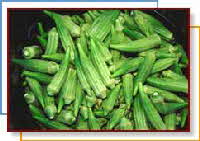
- CLEMSON variety is dark green with angular pods. This okra takes less than two months to mature.
- EMERALD type is dark green, with smooth round pods.
- LEE is a spineless type known by its deep bright green, very straight angular pods.
- ANNIE OAKLEY is a hybrid, spineless kind of okra with bright green, angular pods. It takes less than two months from seeding to maturity.
- CHINESE Okra is a dark green type grown in California and reaches 10 to 13 inches in length. These extra-long okra pods are sometimes called "ladyfingers."
- PURPLE Okra a rare variety you may see at peak times. There is a version grown for its leaves that resemble sorrel in New Guinea.
Availability, Selection, and Storage
Okra is available year-round, with a peak season during the summer months. It is available either frozen or fresh. When buying fresh okra, make sure that you select dry, firm, okra. They should be medium to dark green in color and blemish-free. Fresh okra should be used the same day that it was purchased or stored paper bag in the warmest part of the refrigerator for 2-3 days. Severe cold temperatures will speed up okra decay. Do not wash the okra pods until ready to use, or it will become slimy.
Preparation
When preparing, remember that the more it is cut, the slimier it will become. Its various uses allow for okra to be added to many different recipes. Okra is commonly used as a thicken agent in soups and stews because of its sticky core. However, okra may also be steamed, boiled, pickled, sautéed, or stir-fried whole. Okra is a sensitive vegetable and should not be cooked in pans made of iron, copper or brass since the chemical properties turns okra black.
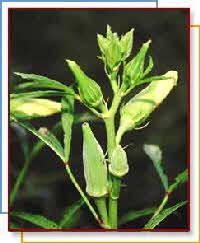
Young Versus Mature Okra - What is the difference?
Most okra pods are ready to be harvested in less than two months of planting. If the okra is going be consumed, then these pods must be harvested when they are very young. They are usually picked when they are two to three inches long, or tender stage.
Okra pods grow quickly from the tender to tough stage. Pods are considered mature when they exceed three inches in length. Mature okra is tough and is not recommended for use in certain recipes.
How do I reduce okra slime?
Most people who have eaten or have cooked okra, know about the okra slime. Some recipes call for the whole okra, but how do you deal with the okra slime?
There are few ways to minimize the slime:
Simply trim the off the ends and avoid puncturing the okra capsule.
You can also minimize the slime factor by avoiding the tendency to overcook okra.
Make Okra Part of Your 5 A Day Plan 
- Boil or microwave whole until just tender. Dress with lemon juice and ground pepper.
- Stew with tomatoes. Serve over rice.
- Add okra to curries or sauté with spices like cumin, coriander, turmeric, or curry powder.
- If okra is used in a soup, stew or casserole that requires longer cooking, it should be cut up, to exude its juices, and thicken.
- Okra pods can be sliced, dipped in egg, breaded with corn meal and baked.
- Sauté okra with corn kernels, onion and sweet peppers for a tasty side dish.
- Okra has a similar flavor to eggplant and can be used as a substitute in your favorite recipes.
- Use raw okra in your tossed salads
RELATED ARTICLES
Please feel free to link to any pages of FoodReference.com from your website.
For permission to use any of this content please E-mail: james@foodreference.com
All contents are copyright © 1990 - 2025 James T. Ehler and www.FoodReference.com unless otherwise noted. All rights reserved.
You may copy and use portions of this website for non-commercial, personal use only.
Any other use of these materials without prior written authorization is not very nice and violates the copyright.
Please take the time to request permission.