JACKFRUIT
The jackfruit (Artocarpus heterophyllus) is a tropical tree originally from western India. There is archaeological evidence of the trees cultivation in India almost 6,000 years ago. Also known as 'jack fruit' (two words); 'jak', 'jak-fruit' or 'jaca' in Malaysia; 'nangka' in the Philippines. In Laos they are 'mak mi' or 'may mi', and 'mit' in Vietnam.
Jackfruit are most extensively grown in India and Sri Lanka, but are also grown in most tropical countries, especially in Southeast Asia, Brazil, and in parts of Africa.
A member of the mulberry family, the jackfruit is a relative of the breadfruit. It is a melon shaped starchy vegetable that can reach a length of 3 feet, and weigh up to 100 pounds, making it the largest tree-borne fruit in the world. The fruits grow both from the tree trunk and from branches in the tree. Jackfruit have a rough spiny skin and the uncut ripe fruit has a strong unpleasant smell, resembling rotting onions - but the cut fruit has a strong aroma similar to papaya or pineapple.
The largest jack fruit in this photo weighs about 60 lbs. and is about 2 feet long. The fruits in the photo on the bottom right are about 15 feet high in the tree and weigh about 20-50 lbs. (click photo to enlarge)
click to enlarge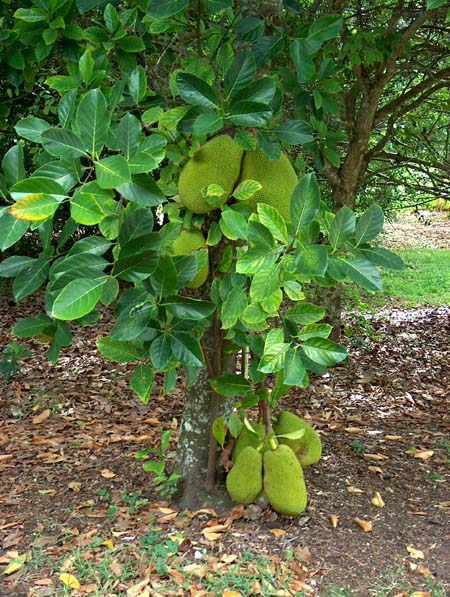 The interior consists of large bulbs of pulp enclosing a seed up to 1 inch long, with from 100 to 500 seeds per fruit. The flavor is similar to pineapple & banana but less juicy. The flavor is sometimes compared to 'Juicy Fruit' gum.
The green unripe flesh of jackfruit is cooked as a vegetable and used in curries, soups and salads. When ripe and sweet, it is eaten as a fruit. They may also be dried or pickled.
Jackfruit are mostly water, with about 8% sugar and 4% starch. 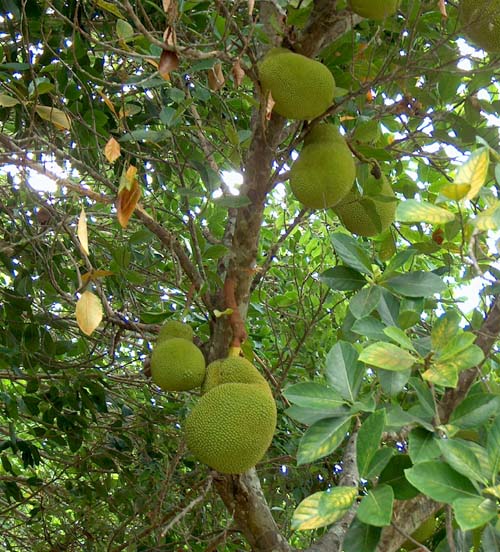 The large seeds are roasted and have a flavor and texture similar to chestnuts. The seeds may also be made into a flour, and the flowers are sometimes used as a vegetable.
The fruits contain a sticky latex, so knives, cutting boards and hands should be coated with oil to protect them before cutting into the fruit.
The wood of jackfruit trees is used in construction, for furniture and musical instruments. The wood was a favored choice for royal palaces in Bali and for temples in Vietnam.
Jackfruit are rarely available fresh in the U.S., but can be found canned in Asian grocery stores.
UPDATE (4/10/12): I live in Winona, Minnesota (population 26,000) and today I came across canned Jackfruit and canned Longan in our local Hy-Vee supermarket. Chef James
Ripe Jackfruit Nutritional Information:
(per 100 grams edible portion)
Water: 83%
Energy: 301 kcal
Vitamin A: 66 ug
Riboflavin: 0.06 mg
Vitamin C: 7.9 mg
Protein: 1.6 g
Fat: 0.2 g
Carbohydrate: 25.4 g
Fiber: 5.6 g
Calcium: 37 mg
Phosphorous: 26 mg
Potassium: 292 mg
Iron: 1.7 mg
Sodium: 48 mg
There is a Jackfruit Festival in Florida in September
Photos by Chef James, taken at Fruit & Spice Park, Homestead, Florida
FREE Magazines
and other Publications
An extensive selection of free magazines and other publications
Also see: Food Articles and Cooking Tips

FOOD TRIVIA and FOOD FACTS
Please feel free to link to any pages of FoodReference.com from your website.
For permission to use any of this content please E-mail: james@foodreference.com
All contents are copyright © 1990 - 2025 James T. Ehler and www.FoodReference.com unless otherwise noted.
All rights reserved. You may copy and use portions of this website for non-commercial, personal use only.
Any other use of these materials without prior written authorization is not very nice and violates the copyright.
Please take the time to request permission.
Popular Pages
CULINARY SCHOOLS
& COOKING CLASSES
From Amateur & Basic Cooking Classes to Professional Chef Training & Degrees
FoodReference.com (since 1999)
Home | Articles | FOOD TRIVIA | Today in Food History | Food_Timeline | Recipes | Cooking_Tips | Food Quotes | Who’s Who | Culinary Schools and Tours | Food_Trivia_Quizzes | Food Poems | Free Magazines | Food Festivals & Events
You are here > Home >
FOOD TRIVIA and FOOD FACTS SECTION