Related Information:
· Arkansas Food Festivals
· Arkansas Culinary Schools
ARKANSAS: FACTS & TRIVIA
FARMS & FARMERS
Arkansas: approximate land area of 33,287,812 acres.
Farmland is 13,872,862 acres or 41.7% of total land.
Organic agriculture accounts for about 23,334 acres.
Number of Farms: 49,346
Principle Farm Operators: Men: 43,015 Women: 6,331
(2013 - USDA Economic Research Service)
[2007-2008 latest available data]
POPULATION & HUNGER
Arkansas has a total population of: 2,937,979
Urban population: 1,781,033 Rural population: 1,156,946
Food insecure households*: 19.2%
Households with very low food security*: 7.6%
*Food insecurity - Limited or uncertain availability of nutritionally adequate and safe foods or limited or uncertain ability to acquire acceptable foods in socially acceptable ways.
Very low food security - At times during the year, eating patterns of one or more household members were disrupted and food intake reduced because the household lacked money and other resources for food.
(2013 - USDA Economic Research Service)
(Population & Food Security data: 2011)
Nearly 9 billion pounds of rice are produced in Arkansas annually, harvesting about 1,785,000 total acres in 2010.
Arkansas produces over one billion broiler chickens each year and ranks second in the nation in broiler production, third in turkeys and eighth in eggs. (2011)
More than 3 million acres of Arkansas land are planted with soybeans, with each acre producing around 35 bushels – yielding nearly 110 million bushels of soybeans during 2010-11.
Pigs were first introduced to Arkansas by the Spanish explorer Hernando de Soto in 1541. Pigs that escaped from his expedition are probably the ancestors of the wild “Razorback” hogs famed as the mascot for the University of Arkansas.
Milk was designated as the official state beverage of Arkansas in 1985.
The Dutch Oven was designated as Arkansas official State Cooking Vessel in 2001.
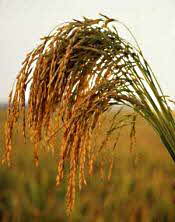 American long-grain rice - public domain photo from USDA Agricultural Research Service Photo Library
In 2007 Arkansas designated Rice as its Official State Grain
Stuttgart, Arkansas is known as 'America's Rice Capital.'
Arkansas is the largest producer of rice in the U.S. accounting for about 46% of U.S. rice production. Rice is grown on about 1.3 million acres in Arkansas. (2008)
The South Arkansas vine ripe pink tomato is Arkansas' official state Fruit AND state vegetable! (designated in 1987)
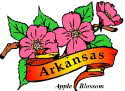
The apple blossom was named the official state flower of Arkansas in 1901.
Alma, Arkansas is the Spinach Capital of the World.
The largest brown trout caught with a fishing pole weighed over 40 pounds and was caught in Arkansas on May 9, 1992.
The white-tailed deer was designated as the Arkansas State Mammal in 1993.
Most people think about turkey for Thanksgiving, but in Stuttgart, Arkansas, the World Championship Duck Calling Contest takes place Thanksgiving week. More than 60,000 people attend the festival, which is the oldest in the state. The first duck-calling contest, held in 1936, had 17 contestants, with the first prize of a hunting coat valued at $6.60. Today the contest is held in six divisions, including junior, intermediate, and women, and the prize is worth more than $15,000.
There are four basic types of duck calls. The 'hail call' is a series of loud, pleading quacks that attract a flock's attention. Once you see ducks react to the hail, either by turning or slowing down, stop hailing them. As the ducks get closer, switch to a 'greeting call,' a series of five excited quacks. Then you use the 'feed call' when they get close. Done properly, it mimics a group of contented ducks on the water. If the ducks are leaving, try the 'come-back call.' It's similar to the greeting call, but with louder, longer, pleading quacks. If your come-back call makes the ducks turn around, go back to the feed call. All of this quacking may sound easy, but it isn't. Just try it and see!
FREE Magazines
and other Publications
An extensive selection of free magazines and other publications
Also see: Food Articles and Cooking Tips

FOOD TRIVIA and FOOD FACTS
Please feel free to link to any pages of FoodReference.com from your website.
For permission to use any of this content please E-mail: james@foodreference.com
All contents are copyright © 1990 - 2025 James T. Ehler and www.FoodReference.com unless otherwise noted.
All rights reserved. You may copy and use portions of this website for non-commercial, personal use only.
Any other use of these materials without prior written authorization is not very nice and violates the copyright.
Please take the time to request permission.
Popular Pages
CULINARY SCHOOLS
& COOKING CLASSES
From Amateur & Basic Cooking Classes to Professional Chef Training & Degrees
FoodReference.com (since 1999)
Home | Articles | FOOD TRIVIA | Today in Food History | Food_Timeline | Recipes | Cooking_Tips | Food Quotes | Who’s Who | Culinary Schools and Tours | Food_Trivia_Quizzes | Food Poems | Free Magazines | Food Festivals & Events
You are here > Home >
FOOD TRIVIA and FOOD FACTS SECTION