
Home | FOOD ARTICLES | Food Trivia | Today_in_Food_History | Food_History_Timeline | Recipes | Cooking_Tips | Food_Videos | Food_Quotes | Who’s_Who | Culinary_Schools_&_Tours | Food_Trivia_Quizzes | Food_Poems | Free_Magazines | Food_Festivals_and_Events
Food Articles, News & Features Section
FREE Magazines
and other Publications
Free Professional and Technical Research, White Papers, Case Studies, Magazines, and eBooks
Water Chestnut
The water chestnut, resembles a chestnut in color and shape, is also known as the Chinese water caltrop. This tuber is commonly associated with Chinese cooking, but is finding its way into other ethnic meals.
Hailing from Southeast Asia, water chestnuts are actually roots of an aquatic plant that grows in freshwater ponds, marshes, lakes, and in slow-moving rivers and streams. These roots are commonly grown in Japan, Taiwan, China, Thailand, and sometimes in Australia.
Water chestnut harvesting is laborious, making them somewhat expensive to purchase. Processed and canned water chestnuts widely found in most supermarkets. However, fresh water chestnuts, are more difficult to find, but are becoming more available.
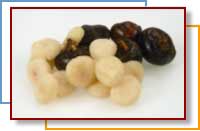
If you find fresh water chestnuts, select those that are firm with no signs of wrinkling. These will need to be peeled prior to eating and cooking. Stored fresh tubers need to be wrapped tightly in a plastic bag for up to one week.
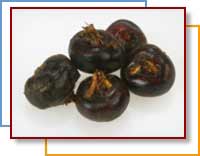
Canned, unopened water chestnuts will store indefinitely. Once opened, canned tubers will keep up to one week in a bowl of water. Be sure to change the water daily for the ‘freshest’ product.
Serving Size (62g)
Amounts Per Serving - % Daily Value*
Calories 30
Calories from Fat 0
Total Fat 0g - 0%
Sodium 5mg - 0%
Cholesterol 0mg - 0%
Total Carbohydrate 8g - 3%
Dietary Fiber 3g - 12%
Sugars 1g
Protein 1g
Vitamin A 0%
Vitamin C 0%
Calcium 0%
Iron 90%
*Percent Daily Values are based on a 2,000 calorie diet.
RELATED ARTICLES
Please feel free to link to any pages of FoodReference.com from your website.
For permission to use any of this content please E-mail: james@foodreference.com
All contents are copyright © 1990 - 2026 James T. Ehler and www.FoodReference.com unless otherwise noted. All rights reserved.
You may copy and use portions of this website for non-commercial, personal use only.
Any other use of these materials without prior written authorization is not very nice and violates the copyright.
Please take the time to request permission.