See also: Article on Turmeric
TURMERIC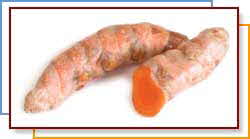
Turmeric is the root of a tropical plant that has been used in cooking since 600 B.C. It is native to the Orient and now can be found in India and the Caribbean. It has a bitter, pungent almost woodsy flavor, is yellowish-orange in color.
The use of turmeric as a coloring agent for food and fabric dates as far back as 600 B.C. Marco Polo, in 1280, mentioned turmeric in notes of his travels in China: 'There is also a vegetable that has all the properties of true saffron, as well as the smell and the color, and yet it is not really saffron.' In medieval Europe, turmeric was known as 'Indian saffron.' Since then, turmeric has been used as an inexpensive substitute for saffron.
The turmeric root has light brown skin and bright reddish-orange flesh. Turmeric was used in biblical times as a perfume but now it is most commonly used to flavor and color food. Ground turmeric is widely used in East Indian cooking particularly in curries as well as other soups and stews.
Fresh turmeric roots should have a spicy fragrance and stubby fingers protruding from the sides of the root. Refrigerate unpeeled turmeric, tightly wrapped, for 3 weeks.
Turmeric is typically boiled or steamed and then dried and ground into powder. Use ground tumeric in fish or rice dishes. Be careful with fresh turmeric, it will stain your hands and clothing.

You are here > Home > FOOD TRIVIA & FACTS >
Please feel free to link to any pages of FoodReference.com from your website.
For permission to use any of this content please E-mail: james@foodreference.com
All contents are copyright © 1990 - 2025 James T. Ehler and www.FoodReference.com unless otherwise noted.
All rights reserved. You may copy and use portions of this website for non-commercial, personal use only.
Any other use of these materials without prior written authorization is not very nice and violates the copyright.
Please take the time to request permission.
FOOD TRIVIA and FOOD FACTS
Also see: Food Articles and Cooking Tips
Popular Pages
Home | Articles | FOOD TRIVIA | Today in Food History | Food Timeline | Recipes | Cooking_Tips | Food Quotes | Who’s Who | Culinary Schools & Tours | Food_Trivia_Quizzes | Food Poems | Free_Magazines | Food Festivals & Events

FoodReference.com (since 1999)
FOOD TRIVIA and FOOD FACTS SECTION