See also: American Buffalo; Passenger Pigeons.
BISON
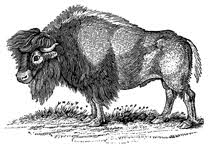
The American Bison (American Buffalo*) species is generally divided into two subspecies:
The Plains Bison of the American West and the larger Wood Bison of the boreal forests in western Canada up through Alaska. The animals can weigh over 2,000 pounds and be over 6 feet tall at the hump.
The Texas Bison Herd at Caprock State Park was designated as the Official Bison Herd of Texas in 2011.
The Bison is the state animal of Oklahoma.
· In the early colonial period bison roamed throughout most of eastern North America. Their sheer size made them an important food source, one animal yielding up to 1,200 pounds of meat.
· By 1770 they had disappeared from America east of the Mississippi.
· In 1850 there were more than 20 million head of bison sharing the western plains with 50 million open range longhorn cattle.
· By 1890 only a few hundred bison remained.
Estimates on the number of bison that roamed the North American continent range from 30 million to over 60 million. Whichever estimate you accept, the fact is that when white civilization began to move west, bison slaughter followed. Some were killed for hides and food; many were killed just for the sport.
The railroads accelerated the slaughter, and it fit with U.S. government policy to kill off the bison, which were the mainstay of the plains Indians. No bison, no Indians. No Indians, more room for white settlers.
By about 1890 there were only 500-900 bison left alive. Out of 30-60 million. Think about it.
Today there are an estimated 350,000 bison in managed herds. (2009)
In 2009 the U.S. produced more than 68,000 American bison for meat. (USDA, 2010)
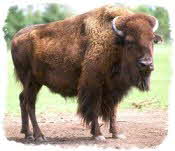
*The National Bison Association encourages the name Bison to differentiate the American buffalo from the Asian Water buffalo and African Cape buffalo. The American buffalo is not a true buffalo. Its scientific name is bison and it belongs to the bovine family along with domestic cattle.
Also see: Food Articles and Cooking Tips
You are here > Home >
Please feel free to link to any pages of FoodReference.com from your website.
For permission to use any of this content please E-mail: james@foodreference.com
All contents are copyright © 1990 - 2025 James T. Ehler and www.FoodReference.com unless otherwise noted.
All rights reserved. You may copy and use portions of this website for non-commercial, personal use only.
Any other use of these materials without prior written authorization is not very nice and violates the copyright.
Please take the time to request permission.
FOOD TRIVIA and FOOD FACTS

Popular Pages
CULINARY SCHOOLS
& COOKING CLASSES
From Amateur & Basic Cooking Classes to Professional Chef Training & Degrees
Home | Articles | FOOD TRIVIA | Today in Food History | Food_Timeline | Recipes | Cooking_Tips | Food Quotes | Who’s Who | Culinary Schools and Tours | Food_Trivia_Quizzes | Food Poems | Free Magazines | Food Festivals & Events
FoodReference.com (since 1999)
FOOD TRIVIA and FOOD FACTS SECTION