See Also: Duck Eggs
DUCKS: DUCK TRIVIA
Ducks waddle because their short legs are positioned to the side of their large breasts, good for swimming but a little awkward for walking. They walk pigeon-toed to keep their balance.
The Wood Duck (Aix sponsa) was designated as the Official Duck of South Carolina in 2009.
Mississippi designated the Wood Duck as its Official State Waterfowl in 1974.
There are 3,473 people in the U.S. listed on whitepages.com with the last name 'Duck'
(Mark Morton, 'Gastronomica', Fall 2010)
All of the Peking (Pekin) ducks in the U.S. are descended from 9 ducks imported to Long Island, New York in 1873. (also called Long Island duckling)
The Labrador Duck was the first endemic North American bird species to be hunted to extinction. The last known Labrador Duck was shot near the shore of Long Island, New York in 1875.
Muscovy Duck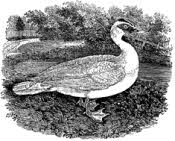
The Muscovy Duck, is a greenish black duck with red wattles, found wild in Mexico and northern South America. The Muscovy was domesticated in South America before the arrival of Columbus. The Muscovy duck and the wild Mallard duck are believed to be the ancestors of modern domestic ducks.
There are about 24 million ducks raised each year in the U.S., and Maple Leaf Farms in California, Wisconsin and Indiana produce almost 2/3rds of them.
Bombay duck is really a small (up to 16 inches) edible lizardfish which in India is salted then sun dried and used as a condiment. It is also used as a food fish in many areas of southern Asia. Also known as bumalo and bombila.
Muscovy ducks are raised to 11 weeks. They are most often selected for their breast meat and liver, which is used to make foie gras. Moulard is a cross between a male Muscovy and a female White Pekin. Like Muscovy, Moulard ducks are most often used for foie gras. Muscovy comprises 3 to 4 percent of U.S. duck consumption; Moulard 1 to 2 percent.
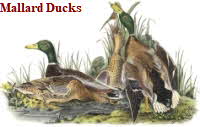
There are three major duckling breeds available in the United States: White Pekin, Muscovy, and Moulard. National consumption increased by 21.3 percent between 1995 and 2000—a percentage increase that outpaces chicken and turkey
White Pekin is the best selling duckling, comprising roughly 95 percent of U.S. duckling consumption. White Pekin duckling are generally raised to 6 to 8 weeks for optimal tenderness.
White Pekin is known for its mild, satisfying flavor that easily adapts into a number of cuisine and menu categories.
White Pekin has a nutritional make-up that still surprises most people. Nutritional information released by the USDA in 1997 proves that skinless White Pekin duckling breast is lower in fat and calories than skinless chicken breast.
Most people think about turkey for Thanksgiving, but in Stuttgart, Arkansas, the World Championship Duck Calling Contest takes place Thanksgiving week. More than 60,000 people attend the festival, which is the oldest in the state. The first duck-calling contest, held in 1936, had 17 contestants, with the first prize of a hunting coat valued at $6.60. Today the contest is held in six divisions, including junior, intermediate, and women, and the prize package is worth more than $15,000.
There are four basic types of duck calls. The 'hail call' is a series of loud, pleading quacks that attract a flock's attention. Once you see ducks react to the hail, either by turning or slowing down, stop hailing them. As the ducks get closer, switch to a 'greeting call,' a series of five excited quacks. Then you use the 'feed call' when they get close. Done properly, it mimics a group of contented ducks on the water. If the ducks are leaving, try the 'come-back call.' It's similar to the greeting call, but with louder, longer, pleading quacks. If your come-back call makes the ducks turn around, go back to the feed call. All of this quacking may sound easy, but it isn't. Just try it and see!
Library of Congress Local Legacies Project
FREE Magazines
and other Publications
An extensive selection of free magazines and other publications
Also see: Food Articles and Cooking Tips

FOOD TRIVIA and FOOD FACTS
Please feel free to link to any pages of FoodReference.com from your website.
For permission to use any of this content please E-mail: james@foodreference.com
All contents are copyright © 1990 - 2025 James T. Ehler and www.FoodReference.com unless otherwise noted.
All rights reserved. You may copy and use portions of this website for non-commercial, personal use only.
Any other use of these materials without prior written authorization is not very nice and violates the copyright.
Please take the time to request permission.
Popular Pages
CULINARY SCHOOLS
& COOKING CLASSES
From Amateur & Basic Cooking Classes to Professional Chef Training & Degrees
FoodReference.com (since 1999)
Home | Articles | FOOD TRIVIA | Today in Food History | Food_Timeline | Recipes | Cooking_Tips | Food Quotes | Who’s Who | Culinary Schools and Tours | Food_Trivia_Quizzes | Food Poems | Free Magazines | Food Festivals & Events
You are here > Home >
FOOD TRIVIA and FOOD FACTS SECTION