See also: Corn Statistics; Article on Corn;
History of Corn; Kitchen Tips; Quotes
CORN TRIVIA and FACTS (Maize)
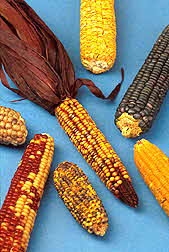
Fresh corn on the cob will lose up to 40% of its sugar content after 6 hours of room temperature storage. The sugar is converted to starch.
There are 5,638 people in the U.S. listed on whitepages.com with the last name 'Corn'
(Mark Morton, 'Gastronomica', Fall 2010)
Corn Belt - The area of the United States where corn is a principal cash crop, including Iowa, Indiana, most of Illinois, and parts of Kansas, Missouri, Nebraska, South Dakota, Minnesota, Ohio, and Wisconsin.
- The official grain of Wisconsin is corn.
- Nebraska is the 'Cornhusker State.'
- Washington, Missouri, is known as the Corn Cob Pipe Capital of the World.
• An average ear of corn has 800 kernels, arranged in 16 rows.
• There is one piece of silk for each kernel.
• A bushel of corn contains about 27,000 kernels.
• Each tassel on a corn plant releases as many as 5 million grains of pollen.
• Corn is an ingredient in more than 3,500 grocery products.
• One bushel of corn can make 33 pounds of sweetener, 32 pounds of starch, or 2 1/2 gallons of ethanol fuel.
• Corn is the 3rd most important food crop of the world measured by production volume, behind wheat and rice. In terms of acreage planted, it is second only to wheat.
In the 1930s, before the machines were available, a farmer could harvest an average of 100 bushels of corn by hand in a nine-hour day. Today’s combines can harvest 900 bushels of corn per hour—or 100 bushels of corn in under 7 minutes!
2012 - Corn was domesticated about 10,000 years ago, most likely from a lost ancestor from the highlands of central Mexico. The oldest remains of corn found at archaeological sites in Mexico resemble popcorn type corn.
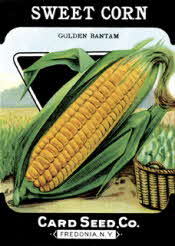
2009 - New evidence has been found for the earliest domestication corn in Mexico about 8,700 years ago (6,700 BC). Domesticated maize (corn) had reached Panama by 5,600 BC and northern South America by 4,000 BC.
Current World Archaeology (#35, 2009)
2006 - Ancient inhabitants of the Andes had more culinary options than previously thought. Evidence for corn processing at a 4,000 year old house on the western Andean slopes, pushed back the date for the earliest cultivation of maize in Peru by 1,000 years. (Archaeology magazine; May-June, 2006)
Corn is used in the production of alcohol, and distilled spirits, corn syrup, sugar, cornstarch, synthetic fibers such as nylon, certain plastics, in the manufacture of wood resin, lubricating oils and synthetic rubber, as an abrasive, corn cob pipes, corn oil, margarine, saccharin, paints, soaps, linoleum and gasohol.
The world record for eating corn on the cob is 33 1/2 ears in 12 minutes, held by Cookie Jarvis. See also: Food Eating Contests
Corn always has an even number of rows on each ear.
A corn ear is actually an inflorescence that produces nearly 1,000 female flowers. These flowers, or potential kernels, are arranged in an even number of rows (usually from 8 to about 22 rows). Row number is always an even number because corn spikelets are borne in pairs, and each spikelet produces two florets: one fertile and one sterile. Stress at a particular stage in development could theoretically produce an ear with an odd number of rows - but I believe if you looked under a microscope, you would find an unseen row that failed to develop fully.
Most things in nature have an even number of rows or lines. Watermelon has an even number of stripes, cantaloupe, etc. Think of it this way. One cell divides into 2 - as cell division continues, there is always an even number.
According to Larousse Gastronomique, here in American we serve boiled or grilled corn on the cob with "redcurrant jelly or maple syrup".
Mitchell, South Dakota is the home of the world's only Corn Palace. (The Corn Palace Festival is in August each year).
Built in 1892 in Mitchell, South Dakota, the Corn Palace was created to dramatically display the products of the harvest of South Dakota's farmers, in murals on the outside of the building. The murals are made from thousands of bushels of corn and other grains and grasses such as wild oats, rye, straw, and wheat. Each year these corn decorations are completely stripped down and entirely new murals are created. The Corn Palace is a great tourist attraction and a meeting place for the community. Many events are held here and the most popular is the Corn Palace Stampede Rodeo. But the horses must be watched carefully so they don't eat the building!
Library of Congress Local Legacies Project
FREE Magazines
and other Publications
An extensive selection of free magazines and other publications
Also see: Food Articles and Cooking Tips

FOOD TRIVIA and FOOD FACTS
Please feel free to link to any pages of FoodReference.com from your website.
For permission to use any of this content please E-mail: james@foodreference.com
All contents are copyright © 1990 - 2025 James T. Ehler and www.FoodReference.com unless otherwise noted.
All rights reserved. You may copy and use portions of this website for non-commercial, personal use only.
Any other use of these materials without prior written authorization is not very nice and violates the copyright.
Please take the time to request permission.
Popular Pages
CULINARY SCHOOLS
& COOKING CLASSES
From Amateur & Basic Cooking Classes to Professional Chef Training & Degrees
FoodReference.com (since 1999)
Home | Articles | FOOD TRIVIA | Today in Food History | Food_Timeline | Recipes | Cooking_Tips | Food Quotes | Who’s Who | Culinary Schools and Tours | Food_Trivia_Quizzes | Food Poems | Free Magazines | Food Festivals & Events
You are here > Home >
FOOD TRIVIA and FOOD FACTS SECTION