CASSAVA TRIVIA (YUCCA)
See also: Article - Yucca
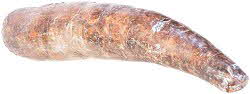
Cassava originated in Brazil. In the 16th century Portuguese sailors brought it to Africa, which now produces more than 50% of the world cassava supply.
This tropical vegetable, also called manioc, manihot, yucca root, yuca root, sweet potato tree and tapioca plant. Cassava is native to South America, in the Amazon Basin of Brazil, and was one of the first cultivated plants in the western hemisphere. It is now also widely cultivated in Indonesia, Malaysia the Philippines and parts of Africa.
Cassava contributes more to the world's calorie budget than any other food except rice and wheat.
Africa accounts for more than 50% of world cassava production.
Cassava leaves are also used as a vegetable in parts of Asia and Africa.
Cassava roots are a source of carbohydrates, but overall have poor nutritional value, containing little protein (1½%), vitamins or minerals. They are also highly perishable if not processed, usually going bad in one day.
Some varieties of cassava contain cyanide compounds and must be cooked thoroughly so as not to case lethal cyanide poisoning.
Scientific American May/2010
Also see: Food Articles and Cooking Tips
You are here > Home >
Please feel free to link to any pages of FoodReference.com from your website.
For permission to use any of this content please E-mail: james@foodreference.com
All contents are copyright © 1990 - 2025 James T. Ehler and www.FoodReference.com unless otherwise noted.
All rights reserved. You may copy and use portions of this website for non-commercial, personal use only.
Any other use of these materials without prior written authorization is not very nice and violates the copyright.
Please take the time to request permission.
FOOD TRIVIA and FOOD FACTS

Popular Pages
CULINARY SCHOOLS
& COOKING CLASSES
From Amateur & Basic Cooking Classes to Professional Chef Training & Degrees
Home | Articles | FOOD TRIVIA | Today in Food History | Food_Timeline | Recipes | Cooking_Tips | Food Quotes | Who’s Who | Culinary Schools and Tours | Food_Trivia_Quizzes | Food Poems | Free Magazines | Food Festivals & Events
FoodReference.com (since 1999)
FOOD TRIVIA and FOOD FACTS SECTION