APPLES IN HISTORY: The Big AppleSee also: Apple Varieties & Usage ; Apple Facts & Trivia ;
Apple Quotes ; Apple Tips
The apple is one of the most ubiquitous foods in the annals of mankind. Few foods are as prevalent in our history, mythology, and psychosocial culture as the apple. This is particularly manifested in the apple's symbolism. It has run the gamut from good to bad; representing love, sensuality, beauty, wisdom, inspiration, temptation and evil. Consider the following:
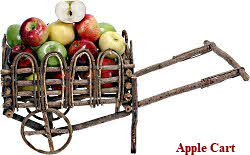
In the premier example of its symbolism, the Devil tempted Eve into sin with an apple. Conversely, in 400 AD, St. Jerome advised his monks to labor on apple and other fruit trees to in order to eschew sloth and the Devil. In Greek mythology, Gaia, or Mother Earth, presented Zeus with a tree of golden apples on his wedding day as a symbol of love. Yet it was this same type of apple that played a role in sparking the legendary Trojan War in ancient Greece. It was a falling apple that supposedly bestowed Isaac Newton with the epiphany that led to his discovery of the laws of gravity and motion. The mythical William Tell shot an apple resting on his son's head to prove his prowess with a crossbow and escape persecution from the government. New York City is known as the "Big Apple." And who could forget Snow White's stepmother's nefarious plan to poison her with an apple? When we love someone they are the "apple of our eye." The apple's health benefits are espoused by the phrase: "An apple a day keeps the doctor away." When we wish to ingratiate our self with the teacher, we give her the gift of an apple. Yet when we wish to add salt to someone's wound, we vengefully query "How do you like those apples?"
Yes, the apple is an anthropological icon. This revered fruit originated in Asia and was first cultivated by man 3,000 years ago. The Romans introduced it to Europe and the Europeans brought it to America in the 17th century. There are approximately 7500 varieties of apples worldwide although only 100 are grown commercially in the US.
(The number of non commercial varieties grown is in excess of 2,000). They are available year round but are at their best in the fall. Choose specimens that are free of any bruises or soft spots. Apples continue to ripen after they are harvested. Apples in good condition, in plastic bags, can last up to six weeks in the refrigerator. At room temperature they will last less than a week. Apples are high in fiber, one type of which, pectin, helps reduce cholesterol. Apples are also high in antioxidants and contain vitamins A and C, and potassium.
Deciding which apple is best for a particular culinary purpose is primarily based on the specific apple's ability to maintain its structural integrity during cooking. For example, Rome, Golden Delicious, Granny Smith and Braeburn hold their shape and texture. They are good choices for baked apples. Empire, Cortland and Mcintosh become somewhat mushy when cooked. Use them for homemade applesauce. For pies, try a combination of both firm and softer apples. Some apples, like Red Delicious, lose flavor when cooked and are best eaten raw. Fuji are also best for the lunchbox.
APPLE CRISPThis recipe comes from Julie Casey, the pastry chef of Tre Vigne Restaurant in basking Ridge, New Jersey FOR THE FILLING:
• 6 granny smith apples, peeled, cored, and sliced
• 2 cups apple juice
• 1 and a half teaspoon cinnamon
• Half teaspoon nutmeg
• Pinch of cloves
• 1 cup brown sugar
• Quarter cup white sugar
• 1 cup dried cranberries DIRECTIONS Place everything except the cranberries in a large pot and bring to a boil. Reduce heat and maintain at a simmer. Meanwhile, mix 3 tablespoons of cornstarch with just enough water to make a paste. Pour into the apple mixture and bring the mixture to a near boil. If the filling still seems liquidity, add one more tablespoon of cornstarch dissolved in a little water. After the cornstarch has been added and the mixture brought to a near boil, remove it from the heat, add the cranberries and set it aside.
FOR THE CRUST:
• 1 cup all purpose flour
• 1 cup instant oatmeal
• 4 oz. brown sugar
• Half teaspoon cinnamon
• Half teaspoon nutmeg
• Pinch of salt
• 5 oz. cold butter, cut into small cubes DIRECTIONS Mix all of the dry ingredients in an electric mixer with the paddle attachment. Then add the butter a piece at a time until a crumbly texture is achieved. Be careful of over mixing or you'll create a dough. If you don't have an electric mixer, mix the dry ingredients in a bowl with a whisk and then cut in the butter with a fork or pastry blender. Place the apple mixture in an 8 x8x2 baking dish. Spoon the crust on top and bake at 400 degrees for 30 minutes or until the top is bubbly and brown. FOOD FOR THOUGHT Mark R. Vogel - Epicure1@optonline.net - Archive |