SALMONSee Also: Salmon Wisdom; Wild Salmon; Salmon Trivia; Salmon Kitchen Tips; Salmon Quotes Canadian gourmets look forward to the arrival of May when Chinook salmon return from their long voyage at sea to spawn in the river of their birth. Scientists still don’t know how salmon manage to find exactly the same river of their birth, but gourmets know that salmon tastes best and “sweetest” just before entering the river of their origin. “Farm-raised” salmon (most market salmon is farm-raised) tastes fatty and is less firm than the natural.
In British Columbia, salmon celebrations start early May and continue through summer with the arrival of different species. West coast aboriginals have always worshipped salmon. Traditionally fish represented life itself and salmon was the best of all. The first caught salmon is shared ceremonially, and its bones returned to sea to ensure an abundant salmon run. Aboriginals also invented ingenious techniques of salmon preservation (salmon candy is an aboriginal specialty of world-wide fame).
Fresh water starts to break down the flesh of salmon, therefore fishermen try to catch it before it enters the estuary. 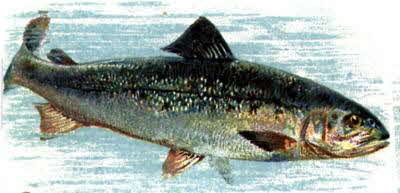 |
After hatching and a few months in the river, salmon migrate to the ocean and return after three to four years to spawn and die. Today, most commercially available salmon is “farm-raised” in crowded pans and fed with scientifically blended feed, not necessarily for taste but for growth. Commercial salmon feed contains ground carrots to provide the colour. Wild salmon’s colour comes from krill, tiny shrimp, on which they feed.
Pen-raised salmon contains more contaminants than wild salmon as it literally “suffocates” in its own feces, and due to overcrowding are more prone to diseases. Farm-raised salmon must be inoculated with antibiotics to prevent the spread of diseases Salmon is indigenous to the Atlantic Ocean, and the best tasting wild salmon still comes from Restigouche in New Brunswick, but this is the privilege of few sports fishermen. Today, most salmon is raised in “farms”, a technique invented by Norwegians who still produce the best” of the lot. Both coasts of Canada boast many salmon farms, as do Chile, and the U. S. A.
Once, salmon was an expensive and revered fish; today farm-raised salmon along with intense competition lowered prices making it readily available to a hungry mass-market.
There are five species of salmon with distinct characteristics:
Chinook – ( spring ) salmon is Pacific’s largest, averaging between 20 lbs (9 kg) to 70 lbs (31kg). And the largest caught on record was 126 lbs. (51.5 kg). Chinook spend three to four years at see before returning to spawn. They start running May and continue to September, and their firm flesh ranging in colour from ivory to deep red is fatty and delicious for grilling. Sockeye ( red salmon) – commonly reach 12 lbs (5.5kg) with an average of 5-8 (3- 3.5kg). They spend up to eight years at sea and start running from July continuing to early September. Sockeye is the most sought after because of its dark colour, high fat content and firm flesh. Coho (a.k.a silver bright) spend one year at sea and average 10 – 20 lbs (4.5 to 9kg). The flesh is firm and turns flaky after cooking. Coho starts running in July and continues to October. They were introduced four decades ago to Ontario’s Great Lakes and still thrive there. Coho is the most widely available salmon. Pink salmon is the smallest (1.5 to 2.5kg) and are abundant representing approximately 60 percent of the entire commercial catch. They are the least
peripatetic salmon, traveling no more than 250 km. from the estuary of their birth. They run July to September and have a delicate pink flesh. Chum – is the second most abundant salmon specie averaging 10 – 15 lbs ( 4.5 to 7 kg), with the lowest fat content. Most of this specie is canned as it does not travel well.
Salmon is available in a variety of forms : net or troll caught ( troll caught tastes better ), fresh or frozen, head-on or off, filleted or not.
The best tasting salmon is fresh ( one day old ), and stored gutted, on ice in the refrigerator. Those just caught tend to be the best, if properly cooked. Chefs and ingenious people invented techniques to preserve salmon.
West Coast Indians invented salmon jerky by brining fillets and hot-smoking the flesh with alder and cherry woods.
Indian candy is treated in a mixture of 40 % sugar and 60% salt, then hot-smoked.
Gravad lax, a Swedish specialty, is produced by marinating salmon in sugar, salt and dill. Scottish and Irish are masters in smoking fish in general, but salmon in particular. English have always revered smoked salmon, especially the type invented in Baltic countries by Jews living in St. Petersburg, Tallinn, and Latvia, and whose ancestors originated in Romania.
Baltic salmon smokers used white salmon and steeped the fillets in a brine, then hot-smoked them over oak sawdust.
After World War I, many of the Jewish fish smokers went to London and “ created “ the “ London cure” based on their old techniques. Here they use the superior quality Scottish salmon, which yields a mush more flavourful smoked salmon. Scottish smoked salmon may be marinated in Scotch whisky, and hot-or cold-smoked. Wild or farmed salmon may be used. Irish salmon tends to be less smoky, versus the Scottish version. Some ingenious Scottish salmon smokers use whisky barrel chips to obtain a uniquely flavoured smoked salmon.
In Paris, Petrosian specializes in smoked salmon, and caviar, selling them at Fauchon at the Place de la Madeleine, and exports to New York.
Canadian east-coast smoked salmon is dark and hot-smoked whereas those produced in Toronto tend to be lighter in texture.
Article contributed by Hrayr Berberoglu, a Professor Emeritus of Hospitality and Tourism Management specializing in Food and Beverage. Books by H. Berberoglu
|