
Home | FOOD ARTICLES | Food Trivia | Today_in_Food_History | Food_History_Timeline | Recipes | Cooking_Tips | Food_Videos | Food_Quotes | Who’s_Who | Culinary_Schools_&_Tours | Food_Trivia_Quizzes | Food_Poems | Free_Magazines | Food_Festivals_and_Events
Food Articles, News & Features Section
FREE Magazines
and other Publications
Free Professional and Technical Research, White Papers, Case Studies, Magazines, and eBooks

PISTACHIO NUTS
See Also: Health Benefits of Pistachio Nuts
A Brief History of Pistachios
The pistachio has a long and interesting history. Native to the Middle East, pistachios are one of the oldest flowering nut trees. Recent archeological evidence in Turkey suggests that humans were enjoying them as early as 7,000 B.C. Flourishing in hot climates, pistachios spread from the Middle East to the Mediterranean, quickly becoming a treasured delicacy among royalty, travelers and common folk alike.
Legend has it that the Queen of Sheba decreed pistachios an exclusively royal food, going so far as to forbid commoners from growing the nut for personal use. Nebuchadnezzar, the ancient king of Babylon, had pistachio trees planted in his fabled hanging gardens. And in the first century A.D., the Emperor Vitellius debuted this prized nut in his capital city of Rome. According to Moslem legend, the pistachio nut was one of the foods brought to Earth by Adam.
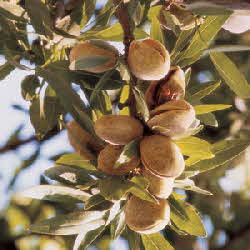
The pistachio has been used as a dyeing agent and a folk remedy for ailments ranging from toothaches to sclerosis of the liver. The pistachio's high nutritional value and long storage life also made it an indispensable travel item among early explorers and traders. Along with almonds, pistachios were frequently carried by travelers across the ancient Silk Road that connected China with the West.
Pistachios in the U.S.
Originally imported in the 1880s for Americans of Middle Eastern descent, pistachios were first introduced to the rest of America as a snack food some 50 years later. Sold in vending machines across the United States, these imported nuts were usually dyed red to mask imperfections and to draw attention from passersby.
Pistachio trees were planted experimentally in California beginning in the early 1930s. After ten years of careful research and selective breeding, one especially hearty variety emerged, named Kerman, after the Middle Eastern city of its origin. By the 1960s, commercial cultivation of pistachios had expanded across California's arid Central Valley. Today, California is the second largest producer of pistachios worldwide, boasting more than 100,000 acres of pistachio orchards and producing in excess of 300 million pounds of pistachios a year, with California accounting for about 98 percent of domestic production.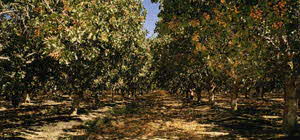 Production has grown rapidly in the U.S., increasing from 4.5 million pounds in 1977 to 346 million pounds in 2004, with a 2005 crop value of $573 million. The rapid growth in the U.S. industry has resulted in it becoming the world's second biggest producer, behind Iran, but ahead of Turkey, Syria, and China. (USDA, 2005)
The Growth Cycle of the Pistachio
Pistachios grow in heavy grape-like clusters, and like almonds, are surrounded by a fleshy hull. Pistachios ripen in late summer or early autumn, their hulls becoming rosy and their inner shells splitting naturally along their sutures.
Pistachio orchards can successfully bear nuts for centuries in what are known as "alternate-bearing" cycles, i.e., their crop yield is heavy one year and light the next. Unlike almonds, pistachios produce male and female flowers on separate trees. Thus, in order for pollination to take place, both male and female trees must be present, or alternately, branches from male trees must be grafted onto their female counterparts. It requires wind - not bees - to carry pollen from male to female flowers.
Climate also plays a role in pistachio production. Pistachio trees require approximately 1,000 hours of temperatures at 45 degrees F. or below to bring about the dormancy necessary for good production. A mild winter or heavy rainfall during pollination can reduce yield.
In the U.S., the bulk of pistachios are harvested in September. At harvest time, mechanical 'tree-shakers' knock the pistachios onto a catching frame, never allowing them to touch the ground. From there the nuts are loaded onto containers and rushed to the processing plant. Pistachio nuts must be hulled and dried immediately to preserve their delicate quality and to prevent their shells from staining.
For additional information visit - pistachiohealth.com
RELATED ARTICLES
Please feel free to link to any pages of FoodReference.com from your website.
For permission to use any of this content please E-mail: james@foodreference.com
All contents are copyright © 1990 - 2026 James T. Ehler and www.FoodReference.com unless otherwise noted. All rights reserved.
You may copy and use portions of this website for non-commercial, personal use only.
Any other use of these materials without prior written authorization is not very nice and violates the copyright.
Please take the time to request permission.