
Home | FOOD ARTICLES | Food Trivia | Today_in_Food_History | Food_History_Timeline | Recipes | Cooking_Tips | Food_Videos | Food_Quotes | Who’s_Who | Culinary_Schools_&_Tours | Food_Trivia_Quizzes | Food_Poems | Free_Magazines | Food_Festivals_and_Events
Food Articles, News & Features Section
FREE Magazines
and other Publications
Free Professional and Technical Research, White Papers, Case Studies, Magazines, and eBooks

POMEGRANATE
See Also: Pomegranate History Timeline; POM Wonderful Variety;
Pomegranate Trivia
What Is It?
A pomegranate is a fruit the size of a large orange. The leathery reddish-pink skin shelters the membranous walls and bitter tissue that house compartments or sacs filled with hundreds of seeds. A translucent red pulp that has a slightly sweet and tart taste surrounds these seeds. Pomegranates are grown in California and throughout Asia and the Mediterranean countries.
Selection and Storage
Pomegranates are available in the United States from September through December. Select fruit that is heavy for its size with bright, fresh color and blemish-free skin. You can refrigerate whole pomegranates for up to 2 months or store them in a cool, dark place for up to a month. Pomegranate seeds packed in an airtight container and stored in the freezer will keep for up to 3 months.
Uses & Preparation
Pomegranates are a versatile fruit and can be used as a garnish on sweet and savory dishes or pressed to extract the juice. To use a pomegranate, cut it in half and pry out the pulp-encased seeds, removing any of the light-colored membrane that adheres. The juice can stain your clothes so be sure to wear an apron or clothing that you don’t mind getting stained.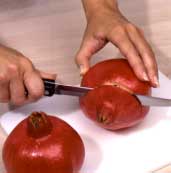
Step 1: Cut the crown end of the pomegranate.
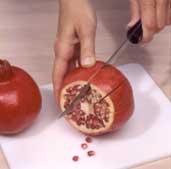
Step 2: Lightly score the rind in several places.
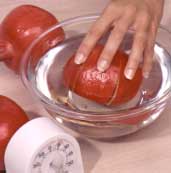
Step 3: Immerse fruit in a bowl of water and soak for 5 minutes.
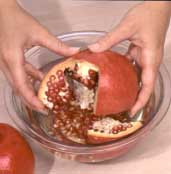
Step 4: Hold fruit under water and break sections apart, separating seeds from membrane. Seeds will sink while rind and membrane float.
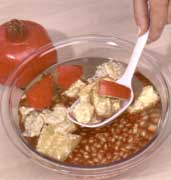
Step 5: Skim off and discard membranes and rind.
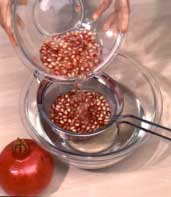
Step 6: Pour seeds into a colander, drain, and pat dry.

- Make Pomegranate Part of Your 5 A Day Plan
- Sprinkle pomegranate seeds over salads, or desserts.
- Use pomegranate extract in marinades or as a glaze for poultry.
- Use pomegranate seeds as a garnish on rice dishes, potatoes, and applesauce.
- Eat pomegranate seeds by the handful — like tiny berries.
- Top waffles, pancakes, or ice cream sundaes with pomegranates seeds.
RELATED ARTICLES
Please feel free to link to any pages of FoodReference.com from your website.
For permission to use any of this content please E-mail: james@foodreference.com
All contents are copyright © 1990 - 2026 James T. Ehler and www.FoodReference.com unless otherwise noted. All rights reserved.
You may copy and use portions of this website for non-commercial, personal use only.
Any other use of these materials without prior written authorization is not very nice and violates the copyright.
Please take the time to request permission.