
Home | FOOD ARTICLES | Food Trivia | Today_in_Food_History | Food_History_Timeline | Recipes | Cooking_Tips | Food_Videos | Food_Quotes | Who’s_Who | Culinary_Schools_&_Tours | Food_Trivia_Quizzes | Food_Poems | Free_Magazines | Food_Festivals_and_Events
Food Articles, News & Features Section
FREE Magazines
and other Publications
Free Professional and Technical Research, White Papers, Case Studies, Magazines, and eBooks
PEPINO MELON
History:
The Pepino melon (Solanum muricatum) is native to the highlands of Peru and Chile, but is now also grown in other South and Central American countries, in California and in New Zealand. The plant is not found in the wild and details of its origin are unknown. They were being grown in California at least by 1889. Today they are popular in Japan.
Other Names
It is also known as treemelon, bush melon, pepino melon, melon pear and mellowfruit. Pepino is Spanish for ‘cucumber’, and the Latin American name pepino dulce means ‘sweet cucumber.’
(‘Pepino’ is also used in some areas of South America for the Cassabanana.)
Description
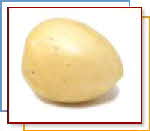
Pepino’s are teardrop shaped and have a smooth skin that is striped with yellow and dark purple. The typical fruit is about 5 inches long and 3 inches in diameter. The flesh of this fruit is fragrant and combines the tastes of cantaloupe and honeydew.
Selection, Storage, and Preparation
Pepinos are available late fall to mid-spring. Fruits with a light yellow or green skin are not ripe, while fruits with dark purple stripes are ripe. Ripen at room temperature until as firm as a slightly ripe plum, then refrigerate ripe fruit for up to 3 days.
Make Pepinos part of your 5 to 9 A Day Plan!
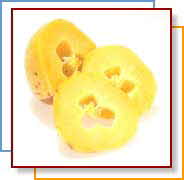
--Pepinos are best served peeled and cubed or sliced.
--Use atop spinach salads.
--Add to fruit medleys.
--Eat plain for breakfast or a light snack.
NUTRITION
Serving Size: 1 medium (100g)
Amount Per Serving % Daily Value
Calories 80
Calories from Fat 0
Total Fat 0g 0%
Saturated Fat --g --%
Cholesterol --mg --%
Sodium 0mg 0%
Total Carbohydrate 22g 7%
Dietary Fiber 5g 20%
Sugars --g
Protein 0g
Vitamin A --%
Vitamin C --%
Calcium --%
Iron --%
* Percent Daily Values are based on a 2,000 calorie diet.
RELATED ARTICLES
Please feel free to link to any pages of FoodReference.com from your website.
For permission to use any of this content please E-mail: james@foodreference.com
All contents are copyright © 1990 - 2025 James T. Ehler and www.FoodReference.com unless otherwise noted. All rights reserved.
You may copy and use portions of this website for non-commercial, personal use only.
Any other use of these materials without prior written authorization is not very nice and violates the copyright.
Please take the time to request permission.