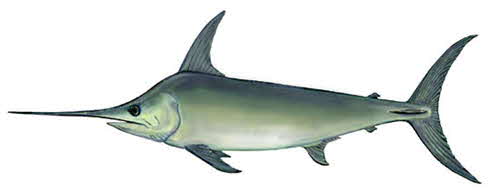
See also Swordfish Recipes SWORDFISHSwordfish, along with marlin, spearfish and sailfish are referred to as billfish. This refers to the sword-like projection of the upper jaw. Swordfish were first described by Aristotle who used the Greek word xiphias meaning "sword." The Romans used the term gladius which also meant "sword." The scientific name for swordfish, Xiphias gladius, is a combination of both names. Swordfish are one of the fastest fish, being able to reach up to 60 mph. They are a solitary fish, and hunt using their sword to slash sideways through schools of smaller fish (e.g. manhaden, mackerel, squid) stunning or killing their prey, then eating at their leisure. Shaped like an oversized mackerel, the body is thickest in the shoulder area, tapering to the tail which is reinforced by a keel on each side. They vary in color from deep brown to black on the back and upper surface of the body to almost white on the side and lower body. The long upper- jaw and snout form a flat, sharp double-edged sword which may be as much as one third the total length of the fish. They are large, aggressive fish sometimes reaching 14 feet in length and a weight of 1,200 pounds.
Swordfish are found throughout the world including Florida's Gulf and Atlantic waters. They feed on a variety of fish and squid, foraging over great depths and distance. They are formidable opponents when harpooned and have been known to pierce the sides and planks of ships with their swords. In recent years, longlines have been used to catch swordfish and have been effective.
SWORDFISH ATTRIBUTESTheir off-white flesh has a firm dense meat-like texture and rich sweet flavor, usually cut into steaks.
SUBSTITUTE SPECIESShark, Tuna, King Mackerel.
HOW MUCH TO BUY• Whole or drawn fish: 3/4 to 1 pound per serving.
• Dressed or cleaned fish: 1/2 pound per serving.
• Fillets or steaks: 1/4 to 1/3 pound per serving.
BUYING, STORAGE AND HANDLINGRemember to purchase seafood last and keep it cold during the trip home. Fresh whole fish should have:
-- A shiny surface with tightly adhering scales.
-- Gills that are deep red or pink, free of slime, mucus and off-odor.
-- Clean shiny belly cavity with no cuts or protruding bones.
-- A mild aroma, similar to the ocean.
Fresh steaks, fillets and loins should have:
-- A translucent look.
-- Flesh that is firm and not separating.
-- A mild odor, similar to the ocean.
-- No discoloration.
-- Packaging that keeps them from being bent in an unnatural position.
PREPARATION• Keep raw and cooked seafood separate to prevent bacterial cross-contamination.
• After handling raw seafood thoroughly wash knives, cutting surfaces, sponges and your hands with hot soapy water.
• Always marinate seafood in the refrigerator.
• Discard marinade; it contains raw juices which may harbor bacteria.
• When marinade is needed for basting reserve a portion before adding raw seafood.
COOKING• The general rule is 10 minutes per inch of thickness, at the thickest part of the fillet or steak, at 400-450 degrees F.
• If fish is cooked in parchment, foil or a sauce, add 5 minutes to the total cooking time.
• Fillets less than 1/2 inch thick do not need to be turned during cooking.
• Fish cooks quickly. Do not overcook.
• Fish is done when the flesh becomes opaque and flakes easily when tested with a fork.
• Poaching, steaming, baking, broiling, sautéing, microwaving are excellent low-fat cooking methods, if you do not add high fat ingredients.
• Marinate in your favorite salad dressing prior to cooking.
• Broil, bake, steam or microwave, then cube and add to pasta or salad greens for a delicious salad.
• Broil or grill with lime-butter and seasoned salt.
• Oil the grill to prevent fish from sticking.
• Bake whole fish with a crab or shrimp stuffing.
• Add leftover fish in broken pieces to salads, soups or sauces.
NUTRITIONNutritional values for approximately 4 ounces (114 grams) of raw, edible portions • Calories 130
• Calories From Fat 35
• Total Fat 4 g
• Saturated Fat 1 g
• Cholesterol 55 mg
• Sodium 105 mg
• Total Carbohydrates 0 g
• Protein 23 g
MERCURY ADVISORYFor women of child-bearing age and small children there health hazards associated with mercury in Swordfish.
For additional information, visit these web sites:
U.S. Food and Drug Administration www.cfsan.fda.gov/seafood1.html
U.S. Environmental Protection Agency www.epa.gov/ost/fish
Florida Department of Agriculture and Consumer Services www.fl-seafood.com
|