FoodReference.com Logo

Food Articles, News & Features Section

Home   |    FOOD ARTICLES   |    Food Trivia & Facts   |    Today in Food History   |    Cooking Tips   |    Recipes   |    Food Quotes   |    Who's Who   |    Videos   |    Trivia Quizzes   |    Crosswords   |    Food Poems   |    Food Posters   |    Cookbook Reviews   |    Shopping   |    Culinary Schools   |    Gourmet Tours   |    Food Festivals & Food Shows

You are here 

> Home  > Food Articles  > Fish & Seafood  > Mahi-Mahi

Next


CULINARY SCHOOLS &
COOKING CLASSES

From Amateur & Basic Cooking Classes to Professional Chef Training & Degrees -  Associates, Bachelors & Masters
More than 1,000 schools & classes listed for all 50 States, Online and Worldwide


Culinary Posters and Art


MAHI-MAHI (Dolphin, Dorado)


See also Mahi-Mahi Recipes - Mahi-Mahi Trivia

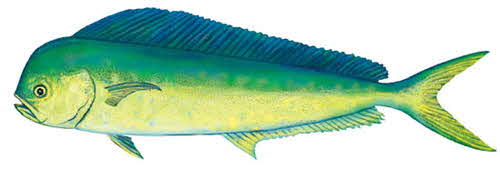
The mahi-mahi (Cotyphaena hippurus), also known as dolphin or dorado, is one of the most beautiful fish in the sea; brilliantly colored with an iridescent bluish green and gold body, and golden yellow fins and tail. The mahi-mahi should not be confused with the mammal called dolphin. One distinguishing characteristic between mature males and females, the male has a very rounded head profile and the female's head slopes down to the mouth.

One of the fastest swimming fish in the sea, they prefer the warmer tropical and subtropical waters of the Caribbean, Gulf of Mexico, and Gulf Coast of Florida. Their spawning season extends from late spring through early summer. Mahi-mahi feed off shore, near the surface, on small fish, shrimp, squid, and crabs and are commercially harvested by hook-and-line.
dolphin fish


MAHI-MAHI ATTRIBUTES
Firm texture, light, sweetly moist meat with solid flake and moderate flavor. Extra lean fish.

SUBSTITUTE SPECIES
Amberjack, Mullet, Pompano, Farm-raised Catfish, Grouper, Tuna.


HOW MUCH TO BUY

    • Whole or drawn fish: 3/4 to 1 pound per serving.

    • Dressed or cleaned fish: 1/2 pound per serving.

    • Fillets or steaks: 1/4 to 1/3 pound per serving.


BUYING, STORAGE AND HANDLING
Remember to purchase seafood last and keep it cold during the trip home.

    Fresh whole fish should have:
    -- A shiny surface with tightly adhering scales.
    -- Gills that are deep red or pink, free of slime, mucus and off-odor.
    -- Clean shiny belly cavity with no cuts or protruding bones.
    -- A mild aroma, similar to the ocean.

    Fresh steaks, fillets and loins should have:
    -- A translucent look.
    -- Flesh that is firm and not separating.
    -- A mild odor, similar to the ocean.
    -- No discoloration.
    -- Packaging that keeps them from being bent in an unnatural position.


PREPARATION

    • Keep raw and cooked seafood separate to prevent bacterial cross-contamination.

    • After handling raw seafood thoroughly wash knives, cutting surfaces, sponges and your hands with hot soapy water.

    • Always marinate seafood in the refrigerator.

    • Discard marinade; it contains raw juices which may harbor bacteria.

    • When marinade is needed for basting reserve a portion before adding raw seafood.


COOKING

    • The general rule is 10 minutes per inch of thickness, at the thickest part of the fillet or steak, at 400-450 degrees F.

    • If fish is cooked in parchment, foil or a sauce, add 5 minutes to the total cooking time.

    • Fillets less than 1/2 inch thick do not need to be turned during cooking.

    • Fish cooks quickly. Do not overcook.

    • Fish is done when the flesh becomes opaque and flakes easily when tested with a fork.

    • Poaching, steaming, baking, broiling, sautιing, microwaving are excellent low-fat cooking methods, if you do not add high fat ingredients.

    • Marinate in your favorite salad dressing prior to cooking.

    • Broil, bake, steam or microwave, then cube and add to pasta or salad greens for a delicious salad.

    • Broil or grill with lime-butter and seasoned salt.

    • Oil the grill to prevent fish from sticking.

    • Bake whole fish with a crab or shrimp stuffing.

    • Add leftover fish in broken pieces to salads, soups or sauces.


NUTRITION
Nutritional values for approximately 4 ounces (114 grams) of raw, edible portions

    • Calories 100  
    • Calories From Fat 10  
    • Total Fat 1 g
    • Saturated Fat 0 g
    • Cholesterol 80 mg
    • Sodium 100 mg
    • Total Carbohydrates 0 g
    • Protein 22 g

Florida Department of Agriculture and Consumer Services  www.fl-seafood.com
 

TOP


RELATED ARTICLES:

Asian Carp Become A Major Problem     |     World Fisheries In Crises     |     Swai Fish (Pangasius)     |     Alaskan Wild Black Cod     |     Amberjack     |     Aquaculture Production & the Environment     |     Bighead Carp     |     Bluefish     |     Catch Shares Fisheries Management     |     Catfish, Farm Raised     |     Caviar From Russia with Love     |     Caviar: Description & Facts     |     Cod: British Gold     |     Cyanide Fishing     |     Fish Facts & Health Benefits     |     Fish Farms: Raising Fish on Inland 'Farms'     |     Fish, Becoming More Expensive by the Day     |     Fish, Something Fishy Going On Here     |     Flounder     |     Grouper     |     Jellyfish     |     King Mackerel     |     King Salmon     |     Komoci Konbu, Herring Eggs on Kelp     |     Mackerel, Wild     |     Mahi-Mahi     |     Mullet     |     Pompano     |     Ocean Fisheries & Overfishing     |     Salmon, Wild or Farmed     |     Salmon of Wisdom     |     Salmon Facts & Types     |     Salmon, Wild Salmon & Dams     |     Sockeye Salmon Record Run    |     Shark     |     Shark Finning     |     Smoked Fish     |     Snapper     |     Spanish Mackerel     |     Striped Bass     |     Sushi Fact Sheet     |     Swordfish     |     Tilapia Description & Facts     |     Tilapia: Grilling Perfect Tilapia     |     Tilefish     |     Trout: Fit for a King     |     Trout In Trouble     |    Atlantic Bluefin Tuna in Trouble     |     Tuna on the Grill     |     Yellowfin Tuna     |     Whales Still Hunted in 2012


Home     |     About Us & Contact Us     |     FOOD ARTICLES     |     Website Bibliography     |     Food Timeline     |     Other Food Links

Please feel free to link to any pages of FoodReference.com from your website.

For permission to use any of this content please E-mail: james@foodreference.com
All contents are copyright © 1990 - 2013 James T. Ehler and www.FoodReference.com unless otherwise noted.
All rights reserved.     You may copy and use portions of this website for non-commercial, personal use only.
Any other use of these materials without prior written authorization is not very nice and violates the copyright.

Please take the time to request permission.


POPULAR PAGES

  Beverage Articles
  Food Facts & Trivia
  Recipe Contests
  Food Shows & Festivals
  Recipe Category Index


Click here to buy posters at Allposters!


FOOD VIDEO SECTION
Recipe Videos, BBQ & Grilling, Food Safety, Food Science, Food Festivals, Beverages, Vintage Commercials, etc.


Order Free Food & Kitchen Catalogs


FREE Food & Beverage Publications
An extensive selection of free magazines and other publications for qualified Food, Beverage & Hospitality professionals