Are Carcinogens released when Charcoal Briquettes are burned?EARTH TALK
From the Editors of E/The Environmental MagazineDear EarthTalk: I saw warnings on bags of charcoal that said carcinogens are released when the briquettes are burned. Is it safe to breathe in the smell of a charcoal grill?
-- Joe Sliwa, via e-mail
Barbecue grills can be problematic for two reasons. First, both charcoal and wood burn “dirty,” producing not only hydrocarbons but also tiny soot particles that pollute the air and can aggravate heart and lung problems. Secondly, the grilling of meat can form two kinds of potentially carcinogenic compounds: polycyclic aromatic hydrocarbons (PAHs) and heterocyclic amines (HCAs).
According to the American Cancer Society, PAHs form when fat from meat drips onto the charcoal. They then rise with the smoke and can get deposited on the food. They can also form directly on the food as it is charred. The hotter the temperature and the longer the meat cooks, the more HCAs are formed.
HCAs can also form on broiled and pan-fried beef, pork, foul and fish, not just on grilled meats. In fact, National Cancer Institute researchers have identified 17 different HCAs that result from cooking “muscle meats” and that may pose human cancer risks. Studies have also shown increased risk of colorectal, pancreatic and breast cancers associated with high intakes of well done, fried or barbequed meats.
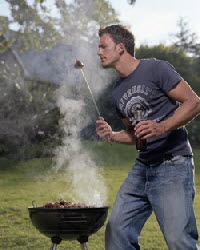 According to the Texas Commission on Environmental Air Quality, Texans who like to say that they “live and breathe barbecue” may be doing just that to the detriment of their health. A 2003 study by scientists from Rice University found that microscopic bits of polyunsaturated fatty acids released into the atmosphere from cooking meat on backyard barbecues were helping to pollute the air in Houston. The city at times registers air quality levels that rank it one of the more polluted U.S. urban areas, though emissions from barbecues are certainly dwarfed by those generated by motor vehicles and industry. According to the Texas Commission on Environmental Air Quality, Texans who like to say that they “live and breathe barbecue” may be doing just that to the detriment of their health. A 2003 study by scientists from Rice University found that microscopic bits of polyunsaturated fatty acids released into the atmosphere from cooking meat on backyard barbecues were helping to pollute the air in Houston. The city at times registers air quality levels that rank it one of the more polluted U.S. urban areas, though emissions from barbecues are certainly dwarfed by those generated by motor vehicles and industry.
Both briquettes and lump charcoal create air pollution. Lump charcoal, made from charred wood to add flavor, also contributes to deforestation and adds to the greenhouse gases in the atmosphere. Charcoal briquettes do have the benefit of being made partly from sawdust (a good use of waste wood), but popular brands may also contain coal dust, starch, sodium nitrate, limestone and borax.
In Canada, charcoal is now a restricted product under the Hazardous Products Act. According to the Canadian Department of Justice, charcoal briquettes in bags that are advertised, imported or sold in Canada must display a label warning of the potential hazards of the product. No such requirements presently exist in the United States.
Consumers can avoid exposure to these potentially harmful additives by sticking with so-called natural charcoal brands. Noram de Mexico’s Sierra Madre 100 percent oak hardwood charcoal contains no coal, oil, limestone, starch, sawdust or petroleum products and, to boot, is certified by the Rainforest Alliance’s SmartWood program as sustainably harvested. The product is available at select Sam’s Clubs across the U.S. Other manufacturers of all natural charcoal include Greenlink and Lazzari, both of which can be found at natural food outlets across North America.
 CONTACTS: Rainforest Alliance SmartWood Program, www.rainforest-alliance.org/programs/forestry/smartwood; Greenlink Charcoal, www.greenlinkcharcoal.com; Lazzari, www.lazzari.com CONTACTS: Rainforest Alliance SmartWood Program, www.rainforest-alliance.org/programs/forestry/smartwood; Greenlink Charcoal, www.greenlinkcharcoal.com; Lazzari, www.lazzari.com
GOT AN ENVIRONMENTAL QUESTION? Send it to: EarthTalk, c/o E/The Environmental Magazine, P.O. Box 5098, Westport, CT 06881; submit it at: www.emagazine.com/earthtalk/thisweek/, or e-mail: earthtalk@emagazine.com. Read past columns at: www.emagazine.com/earthtalk/archives.php |