
Home | FOOD ARTICLES | Food Trivia | Today_in_Food_History | Food_History_Timeline | Recipes | Cooking_Tips | Food_Videos | Food_Quotes | Who’s_Who | Culinary_Schools_&_Tours | Food_Trivia_Quizzes | Food_Poems | Free_Magazines | Food_Festivals_and_Events
Food Articles, News & Features Section
FREE Magazines
and other Publications
Free Professional and Technical Research, White Papers, Case Studies, Magazines, and eBooks

BLACK PEPPER FIELD REPORT
See also: Pepper; Red Pepper
Spice Buyer's Journal: Indonesia
I’m Al Goetze, McCormick’s chief spice buyer, here with a report on Indonesia’s black pepper crop. This is one of the key regions from which McCormick sources its black pepper. The harvest is in full swing, and from now through late July, farmers will be hard at work in the fields. In this installment of the Spice Buyer’s Journal, I’m excited to give you a behind the scenes look at America’s most popular spice.
Historical Treasure to Modern Day Staple
Ask a spice buyer to name the most important spice in his daily monitoring, and the answer will be a resounding, “black pepper.” Black pepper’s importance has been historically documented, as well. Known as “king of the spices,” black pepper once was used as money to pay taxes, tributes, dowries, and rent. Peppercorns were weighed like gold and used as a common medium of exchange. Black pepper was even used as ransom when the Visigoths captured Rome in 410 A.D.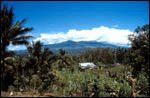 Famous explorers, including Vasco de Gama and Christopher Columbus, sought India’s Malabar Coast in hopes of gaining access to pepper’s source. Later, American clipper ships traveled the high seas to far away tropical lands to buy black pepper and other spices in order to meet the rapidly increasing demand at home.
McCormick spice buyers still travel directly to the source to purchase the finest black pepper. Fortunately, today instead of taking a month or more to get there, we can reach the heart of most major growing areas in less than 30 hours. Black pepper has indeed become a staple in the American pantry. It is the number one selling spice in the United States, representing nearly 10 percent of all retail spice sales.
Exploring Indonesian Pepper
Indonesian black pepper, called Lampung Pepper, is named for the area in which it grows: the Lampung province in southern Sumatera. Lampung is viewed as one of the finest pepper varieties because of its burning pungency, taste and aroma. To reach the growing fields, one must fly to the port city of Bandar Lampung, then travel north to Kotaburni, which is the major collection point in the Indonesian pepper supply chain. Although it is only about 40 miles from Bandar Lampung to Kotaburni, at this time of year the drive takes four hours. Enormous potholes and a steady stream of traffic — including buses, trucks, cattle, sheep, and people — render the narrow road a virtual obstacle course. Farmers and small spice dealers work the street to find the best price for their pepper. This process provides our first peek into crop and price projections.
After dining on satay and a spicy dish called rendang at a small sidewalk café, my local guide and I travel another two hours north to the heart of the pepper growing area. The roads here are less congested and I have the opportunity to relish the beauty of the Indonesian countryside. Magnificent green flora surrounds us on all sides and gorgeous volcanic peaks are visible in the distant background.
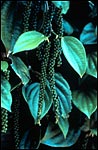
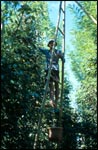
When we finally reach the farms, we see rows upon rows of slender trees, about 20 feet tall, supporting well-developed pepper vines. Between the rows, farmers are perched upon tripod-like ladders, handpicking pepper spikes one at a time. Each spike holds 30-70 pepper berries.
Once harvested, the berries are spread out on grass mats in front of the farmers’ houses to sun dry. During this drying process, which lasts about seven to 10 days, the berries are turned frequently and are brought inside every night for safekeeping. When berries are fully dried and have turned black, they are stored inside the farmer’s house until he is ready to sell them. The lag time can be a few days or, in some cases, many months. One farmer, who invited us in to his home, is a perfect example of the latter. Treating us like old friends, he showed us a sack of pepper that he’s kept hidden under his bed since last year’s harvest. He explained that it was his savings account and the best way he knew to keep his crop from disappearing in the very competitive market.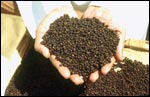 In 2003, most of the Indonesian pepper plants experienced a bumper crop. As a result of that, and an excessively rainy growing season, there are not many spikes on the vines this year, and early harvest indicators point to a small yield. Fortunately, the pepper harvests in Vietnam and Brazil have been fruitful, so there will still be ample supply to meet the global demand.
About McCormick
McCormick was founded in 1889 in Baltimore, Md. Today it is the largest spice company in the world. McCormick sources only the finest ingredients from around the globe to bring the highest quality flavors to consumers. For more information, visit McCormick online at www.mccormick.com, or call 1-800-MEAL-TIP (1-800-632-5847).
RELATED ARTICLES
Please feel free to link to any pages of FoodReference.com from your website.
For permission to use any of this content please E-mail: james@foodreference.com
All contents are copyright © 1990 - 2025 James T. Ehler and www.FoodReference.com unless otherwise noted. All rights reserved.
You may copy and use portions of this website for non-commercial, personal use only.
Any other use of these materials without prior written authorization is not very nice and violates the copyright.
Please take the time to request permission.