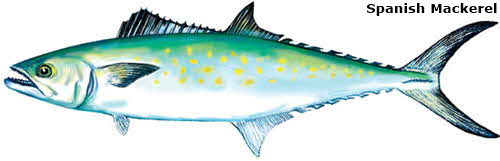
SPANISH MACKERELSee also: Spanish Mackerel Recipes - King Mackerel - Wild Mackerel
Now is the time to enjoy delicious, healthy Spanish Mackerel. Spanish Mackerels have darker meat and are one of the tastiest of the Mackerel family. Spanish Mackerels are also one of the richest sources for Omega-3 fatty acids. These are the polyunsaturated fatty acids with huge health benefits. They are easily filleted and excellent eating baked, broiled, steamed, smoked, poached, or fried. DESCRIPTIONSpanish Mackerels are beautifully colored finfish caught off both Florida coasts. Their slender bullet-shaped bodies are blue and silver, spotted with golden yellow or olive ovals. They are distinguished from the Cero or King Mackerel in having these spots without stripes on the sides, and in lacking scales on the pectoral fins. Spanish Mackerels are members of the large family of fish that include the Tunas and other Mackerels. Although these fish vary greatly in size, they share many common characteristics including being very fast, powerful swimmers. The average size of Spanish Mackerel is from 2-3 pounds, while a weight of 9-10 pounds is considered large. Spanish Mackerels are considered coastal pelagic fin fish, forming immense, fast-moving schools that range the open seas of the Atlantic Ocean, from New York to the Gulf of Mexico. In the late summer and early fall this species migrates southward to spend the winter and early spring along Florida's southern coast. Spanish Mackerels do not appear to move freely around the Florida Keys, creating separate Gulf and Atlantic populations.
SPANISH MACKEREL ATTRIBUTESModerate texture, dark meat with full flavor. Lean fish. SUBSTITUTE SPECIESMullet, Swordfish, King Mackerel.
HOW MUCH TO BUY • Whole or drawn fish: 3/4 to 1 pound per serving.
• Dressed or cleaned fish: 1/2 pound per serving.
• Fillets or steaks: 1/4 to 1/3 pound per serving.
BUYING, STORAGE AND HANDLINGRemember to purchase seafood last and keep it cold during the trip home. Fresh whole fish should have:
-- A shiny surface with tightly adhering scales.
-- Gills that are deep red or pink, free of slime, mucus & off-odor.
-- Clean shiny belly cavity with no cuts or protruding bones.
-- A mild aroma, similar to the ocean. Fresh steaks, fillets and loins should have:
-- A translucent look.
-- Flesh that is firm and not separating.
-- A mild odor, similar to the ocean.
-- No discoloration.
-- Packaging that keeps them from being bent in an unnatural position.
PREPARATION• Keep raw and cooked seafood separate to prevent bacterial cross-contamination.
• After handling raw seafood thoroughly wash knives, cutting surfaces, sponges and your hands with hot soapy water.
• Always marinate seafood in the refrigerator.
• Discard marinade; it contains raw juices which may harbor bacteria.
• When marinade is needed for basting reserve a portion before adding raw seafood.
COOKING
• The general rule is 10 minutes per inch of thickness, at the thickest part of the fillet or steak, at 400-450 degrees F.
• If fish is cooked in parchment, foil or a sauce, add 5 minutes to the total cooking time.
• Fillets less than 1/2 inch thick do not need to be turned during cooking.
• Fish cooks quickly. Do not overcook.
• Fish is done when the flesh becomes opaque and flakes easily when tested with a fork.
• Poaching, steaming, baking, broiling, sautéing, microwaving are excellent low-fat cooking methods, if you do not add high-fat ingredients.
• Marinate in your favorite salad dressing prior to cooking.
• Broil, bake, steam or microwave, then cube and add to pasta or salad greens for a delicious salad.
• Broil or grill with lime-butter and seasoned salt.
• Oil the grill to prevent fish from sticking.
• Bake whole fish with a crab or shrimp stuffing.
• Add leftover fish in broken pieces to salads, soups or sauces.
NUTRITIONNutritional values for approximately 4 ounces (114 grams) of raw, edible portions • Calories 150
• Calories From Fat 50
• Total Fat 6 g
• Saturated Fat 2 g
• Cholesterol 85 mg
• Sodium 55 mg
• Total Carbohydrates 0 g
• Protein 23 g
Florida Department of Agriculture and Consumer Services www.fl-seafood.com |