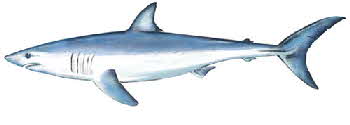
SHARKSee also: Shark Trivia; Shark Recipes; Shark Finning: A Nasty Business These ancient creatures have changed little over millions of years. They are characterized by a cartilaginous skeleton (no true bones), 5-7 pairs of gills and moveable eyelids. Except for the tail, sharks do not use their fins for propulsion but use their pectoral and dorsal fins for stabilization and balance. Most give live birth after a gestation period ranging from six months to two years, but some sharks lay eggs.
Over one hundred species of shark are found in North America waters. Most of the popular Gulf and South Atlantic sharks are in the Carcharinidae family (tiger, sandbar, dusky, blacktip, and silky).
Sharks yield more marketable products than any other single group of fishes. The flesh is used for food; the liver yields oils and vitamins; they can be rendered into fish meal or fertilizer; the skin can be processed into leather; they are used for biomedical research and dissection in anatomy courses; and their teeth often become jewelry.
 Proper handling is the key to the flavor in shark meat. Once landed the shark must be bled and iced immediately. Shark meat can be presoaked in a light brine solution or milk to neutralize any residual ammonia. The dark meat along the lateral line and under the skin should be trimmed away to prevent "off" flavors. Most commercially caught sharks have been pretreated and should not require special attention. Proper handling is the key to the flavor in shark meat. Once landed the shark must be bled and iced immediately. Shark meat can be presoaked in a light brine solution or milk to neutralize any residual ammonia. The dark meat along the lateral line and under the skin should be trimmed away to prevent "off" flavors. Most commercially caught sharks have been pretreated and should not require special attention.
SHARK ATTRIBUTESFirm, white meat with no bones and a mild flavor. Extra lean fish.
SUBSTITUTE SPECIESGrouper, Swordfish, Tilefish, Amberjack..-
HOW MUCH TO BUY• Whole or drawn fish: 3/4 to 1 pound per serving.
• Dressed or cleaned fish: 1/2 pound per serving.
• Fillets or steaks: 1/4 to 1/3 pound per serving.
BUYING, STORAGE AND HANDLINGRemember to purchase seafood last and keep it cold during the trip home. Fresh whole fish should have:
-- A shiny surface with tightly adhering scales.
-- Gills that are deep red or pink, free of slime, mucus and off-odor.
-- Clean shiny belly cavity with no cuts or protruding bones.
-- A mild aroma, similar to the ocean. Fresh steaks, fillets and loins should have:
-- A translucent look.
-- Flesh that is firm and not separating.
-- A mild odor, similar to the ocean.
-- No discoloration.
-- Packaging that keeps them from being bent in an unnatural position.
PREPARATION• Keep raw and cooked seafood separate to prevent bacterial cross-contamination.
• After handling raw seafood thoroughly wash knives, cutting surfaces, sponges and your hands with hot soapy water.
• Always marinate seafood in the refrigerator.
• Discard marinade; it contains raw juices which may harbor bacteria.
• When marinade is needed for basting reserve a portion before adding raw seafood.
COOKING• The general rule is 10 minutes per inch of thickness, at the thickest part of the fillet or steak, at 400-450 degrees F.
• If fish is cooked in parchment, foil or a sauce, add 5 minutes to the total cooking time.
• Fillets less than 1/2 inch thick do not need to be turned during cooking.
• Fish cooks quickly. Do not overcook.
• Fish is done when the flesh becomes opaque and flakes easily when tested with a fork.
• Poaching, steaming, baking, broiling, sautéing, microwaving are excellent low-fat cooking methods, if you do not add high fat ingredients.
• Marinate in your favorite salad dressing prior to cooking.
• Broil, bake, steam or microwave, then cube and add to pasta or salad greens for a delicious salad.
• Broil or grill with lime-butter and seasoned salt.
• Oil the grill to prevent fish from sticking.
• Bake whole fish with a crab or shrimp stuffing.
• Add leftover fish in broken pieces to salads, soups or sauces.
NUTRITIONNutritional values for approximately 4 ounces (114 grams) of raw, edible portions Calories 100
Calories From Fat 5
Total Fat .5 g
Saturated Fat 0 g
Cholesterol 40 mg
Sodium 80 mg
Total Carbohydrates 1 g
Protein 22 g
MERCURY ADVISORYFor women of child-bearing age and small children there health hazards associated with mercury in Shark.
For additional information, visit these web sites:
U.S. Food and Drug Administration www.cfsan.fda.gov/seafood1.html
U.S. Environmental Protection Agency www.epa.gov/ost/fish
Florida Department of Agriculture and Consumer Services www.fl-seafood.com
|