MULLET FISHThe two most commercially harvested species of mullet fish in Florida are the striped mullet (Mugil cephalus) and white mullet (Mugil curema). The striped mullet is commonly called a black mullet, gray mullet or jumping mullet and the white mullet is called a silver mullet.
(Mullet Recipes)
DESCRIPTION AND DISTRIBUTIONMullet are found worldwide in tropical and subtropical waters including the bays and estuaries on Florida's Atlantic and Gulf Coasts. The primary commercial fishery area in Florida is along the Gulf Coast. The body of the mullet fish is elongated and rather stout. The color is a dark bluish on the top and silver along the sides. It has a small mouth with closely set teeth and widely separately dorsal fins. The large scales along the sides of the striped mullet consist of a dark center giving a distinct illusion of horizontal stripes. The average weight is 2 to 3 pounds, but can be in excess of 6 pounds.
Mullet swim in large schools and are commonly seen jumping out of the water, hence the name jumping mullet. This makes it easy for fishermen to spot the fish even in the dark. Mullet feed on aquatic plants and algae found floating, attached to the bottom or mixed in with surface sediments. The mullet is considered a vegetarian and is the only fish that has a gizzard, much like a chicken, that is used to grind up and digest plant material. Commercial harvesters use a cast, beach or haul seine net to catch mullet. 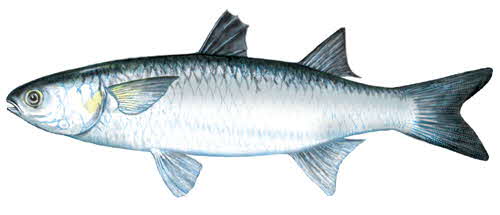 |
MULLET ATTRIBUTESFirm texture, light meat with moderate flavor. Lean fish.
SUBSTITUTE SPECIESMahi-Mahi, Pompano, Spanish Mackerel, Amberjack.
HOW MUCH TO BUY• Whole or drawn fish: 3/4 to 1 pound per serving.
• Dressed or cleaned fish: 1/2 pound per serving.
• Fillets or steaks: 1/4 to 1/3 pound per serving.
BUYING, STORAGE AND HANDLINGRemember to purchase seafood last and keep it cold during the trip home.
Fresh whole fish should have:
-- A shiny surface with tightly adhering scales.
-- Gills that are deep red or pink, free of slime, mucus and off-odor.
-- Clean shiny belly cavity with no cuts or protruding bones.
-- A mild aroma, similar to the ocean.
Fresh steaks, fillets and loins should have:
-- A translucent look.
-- Flesh that is firm and not separating.
-- A mild odor, similar to the ocean.
-- No discoloration.
-- Packaging that keeps them from being bent in an unnatural position.
PREPARATION• Keep raw and cooked seafood separate to prevent bacterial cross-contamination.
• After handling raw seafood thoroughly wash knives, cutting surfaces, sponges and your hands with hot soapy water.
• Always marinate seafood in the refrigerator.
• Discard marinade; it contains raw juices which may harbor bacteria.
• When marinade is needed for basting reserve a portion before adding raw seafood.
COOKING MULLET FISH• The general rule is 10 minutes per inch of thickness, at the thickest part of the fillet or steak, at 400-450 degrees F.
• If fish is cooked in parchment, foil or a sauce, add 5 minutes to the total cooking time.
• Fillets less than 1/2 inch thick do not need to be turned during cooking.
• Fish cooks quickly. Do not overcook.
• Fish is done when the flesh becomes opaque and flakes easily when tested with a fork.
• Poaching, steaming, baking, broiling, sautéing, microwaving are excellent low-fat cooking methods, if you do not add high fat ingredients.
• Marinate in your favorite salad dressing prior to cooking.
• Broil, bake, steam or microwave, then cube and add to pasta or salad greens for a delicious salad.
• Broil or grill with lime-butter and seasoned salt.
• Oil the grill to prevent fish from sticking.
• Bake whole fish with a crab or shrimp stuffing.
• Add leftover fish in broken pieces to salads, soups or sauces.
NUTRITIONNutritional values for approximately 4 ounces (114 grams) of raw, edible portions
• Calories 130
• Calories From Fat 35
• Total Fat 4 g
• Saturated Fat 1.5 g
• Cholesterol 55 mg
• Sodium 85 mg
• Total Carbohydrates 0 g
• Protein 21 g
Florida Department of Agriculture and Consumer Services www.fl-seafood.com
|