GLOBAL FOOD SYSTEMEarthTalk®
E - The Environmental Magazine Dear EarthTalk: I understand a recent government report concluded that our global food system is in deep trouble, that roughly two billion people are hungry or undernourished while another billion are over consuming to the point of obesity. What’s going on?
-- Ellie Francoeur, Baton Rouge, LA (3/27/2011) The report in question, the Global Farming & Futures Report, synthesized findings collected from more than 400 scientists spanning 34 countries, and was published in January 2011 by the British government’s Department for Business Innovation & Skills. Its troubling bottom line conclusion is that the world’s existing food system is failing half of the people on the planet.
Economic inequality among nations and other factors have contributed to a global food system whereby a billion people are hungry (lacking access to sufficient amounts of macronutrients, e.g. carbohydrates, fats and proteins), another billion suffer from “hidden hunger” (lacking crucial vitamins and minerals from their diet), while yet another billion are “substantially over-consuming” (spawning a new public health epidemic involving chronic conditions such as type 2 diabetes and widespread cardiovascular disease). 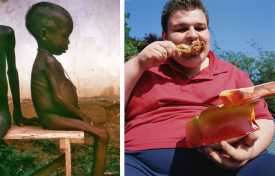 Credit: Left to right: Dr. Lyle Conrad; Digital Vision, Courtesy Thinkstock Credit: Left to right: Dr. Lyle Conrad; Digital Vision, Courtesy Thinkstock
Economic inequality among nations and other factors have contributed to a global food system whereby two billion people are seriously undernourished while another billion are substantially over-consuming.
|
|
The report, which was prepared by the research firm Foresight on behalf of the British government, also predicts that the cost of food worldwide will rise sharply in coming decades, increasing the likelihood of food-based conflicts and migration, and that people won’t be able to feed themselves without destroying the planet—unless we can transform the global food system on the scale of the industrial revolution.
“The global food system is spectacularly bad at tackling hunger or at holding itself to account,” Lawrence Haddad, director of the Institute of Development Studies and an author of the report, told the UK’s Guardian.
The report warns that an expanding world population that is already overexploiting its natural resources is a recipe for disaster, especially given the onset of climate change. “Farmers have to grow more food at less cost to the environment,” said Caroline Spelman of the UK’s Department of Environment, Food and Rural Affairs (DEFRA), which commissioned the report. That may sound simple, but many factors determine if production of a given food is economically viable.
Fixing the global food system will be no small task. Fundamental will be the spreading of existing knowledge and technology to the developing world to boost yields. Other keys to such an endeavor include dramatically reducing food waste—Americans toss as much as 40 percent of their food—especially since food production and distribution accounts for as much as a third of global greenhouse gas emissions. Also, researchers suggest that investing in genetically modified crops and cloned livestock, despite the potential risks, may be “essential in light of the magnitude of the challenges.”
What can those of us in developed nations do? Staying active and eating right is the best way to prevent obesity and ensuing health problems. And choosing locally produced food over that which is shipped in from far away will help reduce our food’s carbon footprint. Also, support the efforts of groups working to end hunger and malnutrition in poor countries. If nothing else, those who wish to help feed the hungry can set their web browsers’ home page to The Hunger Site and click on a button there once a day which triggers a donation of food from one of a number of sponsors to needy people in developing countries.
CONTACTS: UK Department for Business Innovation & Skills, www.bis.gov.uk; DEFRA, www.defra.gov.uk; The Hunger Site, thehungersite.greatergood.com/clickToGive/ths/home
EarthTalk® is written and edited by Roddy Scheer and Doug Moss and is a registered trademark of E - The Environmental Magazine ( www.emagazine.com). Send questions to: earthtalk@emagazine.com Subscribe: www.emagazine.com/subscribe. Free Trial Issue: www.emagazine.com/trial
|